
Rural Roads Too Dark? AOK Solar Street Light SD Series Problem–Solution Guide
If a rural or residential road still looks dark months after solar street lights were installed, the solar concept is rarely the problem. The cause is usually a specification error: a power class chosen without measuring the carriageway, an optical distribution that throws light onto verges instead of the road, or a mounting height that was fixed by the pole rather than by the layout. The AOK Solar Street Light SD series is built to be selected against the road rather than against a catalogue page — a 20–120 W platform with LED efficacy up to 210 lm/W, T2/T3/T4/T5 optical distributions, and mounting heights from 3 m to 12 m for standard urban and rural roads and residential areas. This guide covers the diagnosis, the matching logic, the long-term maintenance plan, and the supply questions that determine whether the road is still properly lit in year five.
Short answer. Rural roads that stay dark after a solar lighting installation usually share five causes: undersized power selection, mismatched optics, incorrect mounting geometry, autonomy designed only for sunny weather, and gradual degradation or water ingress. The fix is a layout-driven selection from the AOK SD series' 20–120 W range with the T2/T3/T4/T5 optic that matches carriageway width and pole spacing, an IP67 MPPT controller with real-time battery monitoring, optional PIR or microwave sensors, and a maintenance plan built around modular replacement instead of whole-luminaire swaps.
Problem definition: five reasons a "lit" road can still read as dark
A completed installation and an adequately lit road are two different outcomes. The first is a procurement event; the second is a photometric and energy result. When the two diverge on a rural or residential road, the gap almost always traces back to one of five decisions taken long before commissioning.
1. Power was narrowed before the road was measured
Rural lighting programmes are often quoted in a single wattage to simplify tendering, and that is exactly how under-lit roads are created. Carriageway width, pole spacing and required uniformity differ from one village lane to the next, so no single power class serves all of them well. The AOK SD series covers 20–120 W, which allows the entry end of the range to be reserved for short, narrow lanes while wider residential and feeder roads draw from the upper end. The order of the decision matters more than the number: road first, wattage second.
2. Optical distribution does not match the carriageway
Two luminaires with identical wattage can produce very different road surfaces depending on how the light is distributed. A narrower distribution concentrates output along the axis of the carriageway; a wider one spreads it across a broader area. AOK offers the SD series with T2, T3, T4 and T5 distributions so the beam pattern can be matched to carriageway width, pole spacing and setback instead of forcing one distribution onto every road in a programme. When the optic is mismatched, the symptom is familiar: bright pools beneath the poles and dark bands between them, even though power consumption looks normal on paper.
3. Mounting height and pole spacing were inherited, not designed
The SD series is designed for mounting heights between 3 m and 12 m on standard urban and rural roads and in residential areas. When an existing pole network is reused without checking height against spacing, mid-span illuminance falls below what residents expect — and raising wattage becomes compensation for geometry rather than a solution. Height, spacing and optic should be reviewed together, because changing one of them shifts the performance of the other two.
4. Autonomy was designed for ideal weather
Solar road lighting is judged in its worst week, not its best. The SD platform pairs a single-side monocrystalline solar panel with MPPT charging and provides 2–3 rainy days of autonomy; on the 80 W model, battery capacity is 614.4 Wh and average charging time is approximately 5 hours. A system sized around a clear-sky average will dim or shut down earlier during a cloudy season, which is one of the most common reasons a recently installed road is reported as "already dark".
5. Degradation and water ingress accumulate quietly
Battery overheating, LED degradation and water ingress are recurring failure modes in outdoor solar lighting. AOK addresses them with overcharge and over-discharge protection, a temperature control system and IP66/IP67 waterproof design, supported by real-time battery monitoring and a regular maintenance service. These measures do not stop ageing, but they make it visible and manageable rather than sudden — which is what decides whether a road stays lit in year three and beyond.
Industry background: from "does it switch on?" to "does it stay usable?"
Outdoor lighting has grown into a large, standards-driven category. Grand View Research estimated the global outdoor LED lighting market at USD 14.20 billion in 2024, while Global Market Insights and Fortune Business Insights placed the global solar street lighting market at roughly USD 5.0 billion to 6.29 billion in 2024. Report scopes differ — some count luminaires only, others include all outdoor sources — so these figures are directionally useful but not interchangeable.
What matters for a rural road project is that technical expectations have been formalised. IEC 60598-2-3, published in Europe as EN 60598-2-3, specifies requirements for luminaires used in road and street lighting. In North America, outdoor luminaires for wet locations are evaluated against UL 1598, and roadway lighting design and maintenance in the United States commonly follows ANSI/IES RP-8-21. Together these frameworks push buyers away from "it lights up" as an acceptance criterion and towards maintained illuminance, uniformity and serviceability across the life of the installation.
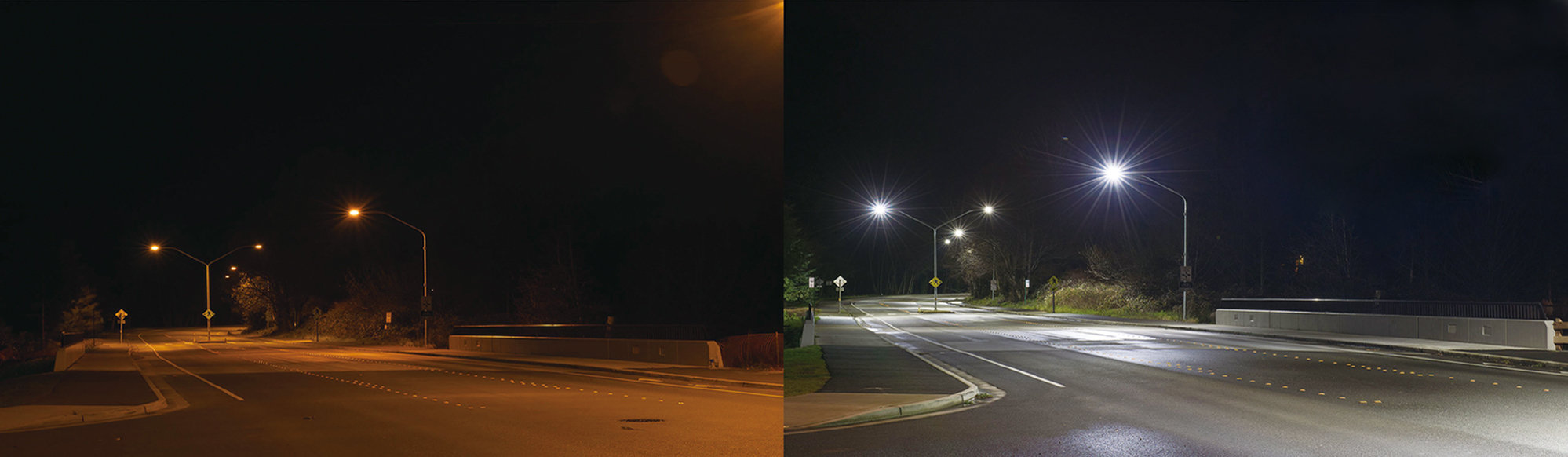
The replacement baseline has shifted too. Against a traditional high-pressure sodium street light, AOK states that its LED street lighting delivers energy savings of up to 80%, extends lifespan by five times, requires up to 90% less maintenance and achieves around 30% higher photoelectric conversion efficiency. Initial cost is approximately 15% higher, while total cost of ownership over five years is approximately 40% lower. For rural programmes, that trade-off is what turns a lighting scheme into a budget line that behaves predictably across its service life.
Detailed solution: what the AOK Solar Street Light SD series provides
AOK Industrial Company Limited is a Shenzhen-based LED lighting manufacturer founded in 2012. Its range covers LED street lights, solar street lights, high mast lights, stadium lights and industrial lighting, with 100% of output exported to markets including the EU, the USA, the Middle East and Asia. The company states that it has served customers in more than 100 countries and completed more than 10,000 projects with over one million units installed, and it holds ISO9001, ISO14001, UL, TUV and RoHS certification alongside long-term supplier relationships with Philips LUMILEDS and Osram.
Within that portfolio, the SD series is the solar street light platform intended for standard urban and rural roads and residential areas. Its selection parameters are narrow and measurable, because a darkness complaint can only be resolved if the luminaire can be re-specified against the actual layout.
| Selection parameter | AOK Solar Street Light SD series |
|---|---|
| Power range | 20–120 W |
| LED efficacy | Up to 210 lm/W |
| Optical distributions | T2 / T3 / T4 / T5 |
| Typical mounting height | 3–12 m (standard urban and rural roads, residential areas) |
| Solar and charging | Single-side monocrystalline panel with MPPT charging; approximately 5 hours average charging on the 80 W model |
| Battery (80 W model example) | 614.4 Wh |
| Autonomy | 2–3 rainy days |
| Controller | MPPT controller, IP67 |
| Sensors | Optional PIR / microwave sensors |
| Monitoring | Potential IoT monitoring for predictive upkeep |
| Maintenance approach | Modular design; standard MPPT controller; easier modular replacement |
| Warranty | Standard 3-year, extendable to 5-year |
| Cost position | Lower initial purchase cost relative to premium heavy-duty alternatives |
Why 210 lm/W changes the economics of a village road
Efficacy decides how much solar hardware a road actually needs. At up to 210 lm/W, the SD series produces more light for every watt consumed, which reduces the panel wattage and battery capacity required to reach the same delivered illuminance on the ground. Two practical outcomes follow: faster charging — approximately 5 hours on the 80 W model — and a lower initial purchase cost, because a lower-power luminaire can be specified without accepting a darker road. Higher efficacy also leaves more headroom during cloudy periods, when charge input drops and every watt of system capacity is doing less work.
Optics: the half of the specification that is usually missing
Optical distribution is where many under-lit roads could have been corrected without spending more money. The SD series offers T2, T3, T4 and T5 distributions, covering progressively wider spreads of light. Narrower options suit constrained lanes where light must travel along the carriageway; wider options suit broader residential streets, junctions and open areas. Choosing the optic at the same time as the wattage is what removes the pattern of bright pools and dark bands that triggers most resident complaints.
Matching the road to the SD platform
| Road situation | Power band to start from (SD: 20–120 W) | Optical distribution to evaluate | Mounting height (SD: 3–12 m) |
|---|---|---|---|
| Narrow village access lane, single-side poles | Lower end of the range | Narrower spread (T2 / T3) | Lower end of the range |
| Residential street, staggered or two-side poles | Mid-range | Medium spread (T3 / T4) | Mid-range |
| Wider rural collector or feeder road | Upper end of the range | Wider spread (T4 / T5) | Upper end of the range |
| Junction, crossing or community square inside the scheme | Matched within the same 20–120 W platform | Widest spread (T5) for open coverage | Per-pole design within 3–12 m |
This table is a starting point for the layout conversation, not a photometric calculation. Final power, optic and mounting height should be confirmed against carriageway width, pole spacing, setback and the uniformity requirement for the road class.
Step-by-step breakdown: from darkness complaint to a commissioned road
- Measure the road, not the drawing. Record carriageway width, pole spacing, existing mounting height within the 3–12 m range, setback and obstructions such as tree canopies. Most "too dark" cases are visible at this stage.
- Define what "dark" means on this road. Note where the failures occur — mid-span bands, junctions, pedestrian edges, or the stretch immediately after a bend. The location of the failure usually points at the optic and mounting height rather than the wattage.
- Shortlist power from the 20–120 W range. Start at the end of the range that matches the measured carriageway instead of defaulting to a programme-wide wattage.
- Choose the optical distribution in the same meeting. Select from T2, T3, T4 and T5 against pole spacing and setback so light lands on the road surface rather than the verge.
- Check the energy budget, not just the fixture. Confirm panel, MPPT charging and battery together: the 80 W model uses a 614.4 Wh battery with approximately 5 hours of average charging and 2–3 rainy days of autonomy, which is the figure that determines cloudy-season performance.
- Configure sensors and controls. Optional PIR and microwave sensors allow output to follow actual road use, and the platform is ready for potential IoT monitoring so battery and luminaire condition can be reviewed without a site visit.
- Confirm capacity, customization and lead time before promising a schedule. AOK states a monthly production capacity of 1,000 units, a lead time of 30–45 days, and customization for appearance and components.
- Agree acceptance and payment terms before shipment. The stated process is pre-shipment testing with third-party inspection available through SGS; delivery terms are EXW, FOB or CIF, with payment at 30% T/T in advance and 70% T/T before shipment, or by LC.
- Plan maintenance and spares from day one. The modular design, the IP67 MPPT controller, real-time battery monitoring and a regular maintenance service are what turn a first installation into a maintainable road lighting asset.
Use cases: three road profiles and the SD configuration each one points to
Village access lane with single-side poles
Short, narrow lanes with one row of poles are the profile most often left too dark, because the light must travel along the road rather than across it. This profile points to the lower end of the 20–120 W range, a narrower T2/T3 distribution, and mounting heights at the lower end of the 3–12 m band. Uniformity along the lane, not peak brightness under the pole, is the acceptance criterion to agree with the community.
Residential street with staggered or two-side poles
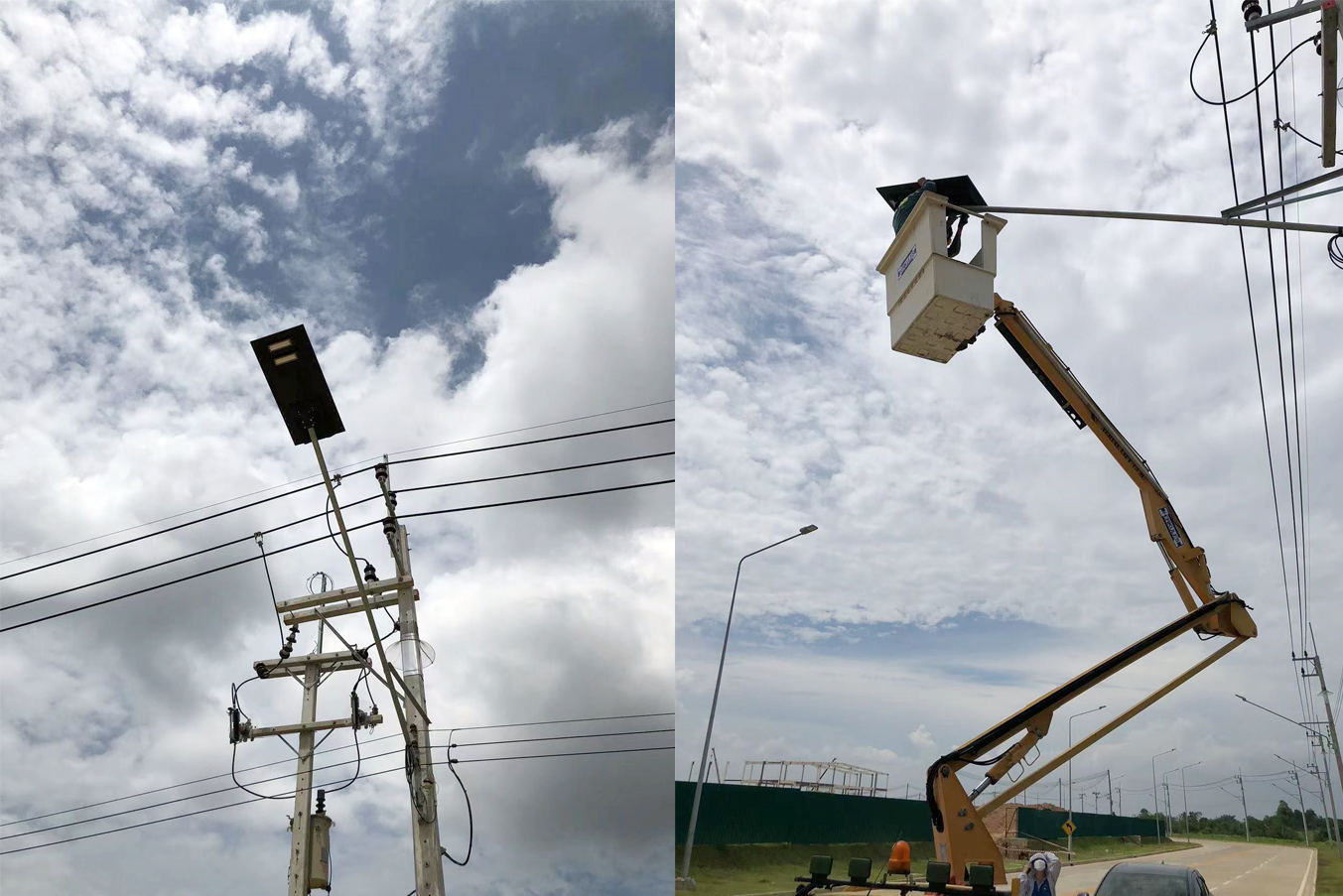
Residential streets usually need broader coverage because pedestrians, driveways and crossings share the surface with vehicles. This profile fits mid-range power, a medium T3/T4 spread and mid-range mounting heights. A documented example of the platform in service is an 80 W SD series installation in Thailand, where the luminaire is deployed on a standard roadside layout rather than a special application.
Wider rural collector or feeder road
Feeder roads carrying buses, agricultural vehicles and through traffic need higher mounting heights and a wider T4/T5 spread so that light reaches across the full carriageway. This is where the upper end of the 20–120 W range and the 3–12 m mounting band are used together, and where the energy budget should be verified against local cloudy-season length before the order is placed.
Comparison table: AOK SD series against a heavy-duty alternative and the HPS baseline
Rural road projects rarely evaluate a single product in isolation. The table below compares the AOK SD series with the Balder BI-S5A, a solar street light designed around a different set of priorities, and then sets both against the high-pressure sodium baseline that many rural programmes are replacing.
| Comparison dimension | AOK Solar Street Light SD series | Balder BI-S5A |
|---|---|---|
| Power range | 20–120 W | 70–120 W |
| LED efficacy | Up to 210 lm/W | 110 lm/W |
| Optical flexibility | Multiple T2 / T3 / T4 / T5 distributions | Not specified in the source comparison |
| Solar panel | Single-side monocrystalline with MPPT | Bifacial double-glass panel |
| Battery (80 W model example) | 614.4 Wh | 538 Wh |
| Average charging time | Approximately 5 hours | Approximately 6 hours |
| Full-power runtime / autonomy | 7.2 hours full-power runtime; 2–3 rainy days autonomy | 12 hours plus 3 nights autonomy |
| Protection and construction | IP67 MPPT controller; IP66/IP67 waterproof design | IP66 + IK10; 205 km/h wind resistance; full metal anti-corrosion design |
| Warranty | Standard 3-year, extendable to 5-year | 10-year fixture / 5-year battery |
| Best-fit environment | Standard urban and rural roads and residential areas, 3–12 m mounting height | Harsh coastal or hurricane-prone environments, for example in Latin America |
| Cost position | Typically lower initial purchase cost | Premium price |
| Maintenance approach | Modular replacement, standard IP67 MPPT controller, optional PIR/microwave sensors, potential IoT monitoring | Tool-free aspects in an all-metal corrosion-resistant build, microwave sensor, long fixture warranty |
The two luminaires optimise different priorities rather than the same one: the SD series targets wide power coverage, high efficacy, flexible optics and cost-sensitive standard roads, while the BI-S5A targets structural durability in extreme wind and coastal environments. Neither design objective is inherently better; they answer different site conditions.
| Metric (LED versus high-pressure sodium baseline) | Stated result |
|---|---|
| Energy saving | Up to 80% |
| Lifespan | Extended by 5 times |
| Initial cost | Approximately 15% higher |
| Total cost of ownership over 5 years | Approximately 40% lower |
| Maintenance requirement | Up to 90% less |
| Photoelectric conversion efficiency | Approximately 30% higher |
Long-term ownership: what to lock down before the first order
A rural road lighting programme is usually judged over five to ten years, not at handover. The decisions that protect that period are commercial, logistical and maintenance-related rather than purely photometric.
Modular maintenance and spare-part strategy
The SD series is built around modular replacement: the standard MPPT controller (IP67) and the main assemblies can be serviced as modules, which reduces the cost of a single failure to a component swap rather than a luminaire replacement. Combined with real-time battery monitoring, this allows a maintenance team to plan interventions around actual condition instead of fixed intervals. Battery overheating, LED degradation and water ingress remain the failure modes to watch, which is why overcharge/discharge protection, a temperature control system and IP66/IP67 waterproof design are relevant to lifecycle cost rather than only to the datasheet.
Sensors, controls and IoT-ready monitoring
Optional PIR and microwave sensors let output respond to actual road use, and the platform supports potential IoT monitoring for predictive upkeep. For a distributor or municipality maintaining hundreds of units across scattered villages, the difference between reactive repair and predictive upkeep is mostly a matter of visibility — knowing which luminaire is degrading before residents report it.
Production capacity, customization and lead time
For planned programmes, AOK states a monthly production capacity of 1,000 units together with a lead time of 30–45 days, and offers customization of appearance and components. Those three numbers (capacity, customization scope, lead time) should be written into the rollout plan, because a phased rural programme usually needs repeat orders rather than a single shipment, and appearance or component customization directly affects both the first order and later batches.
Commercial and acceptance terms
Stated purchasing terms are straightforward to plan around: MOQ varies depending on the product type; delivery terms are EXW, FOB or CIF; acceptance criteria are pre-shipment testing with third-party inspection available through SGS; and payment is 30% T/T in advance with 70% T/T before shipment, or by LC. For multi-village rollouts, pre-shipment inspection is the practical check that the delivered configuration matches the specified power and optic.
Supply continuity and channel partnership
Long-term road lighting programmes are rarely one-off purchases. They are typically staged across budget cycles, which makes supply continuity, warranty extension and spare-part availability the real basis of a distributor or municipality relationship. The SD series supports that model through its standard 3-year warranty with an option to extend to 5-year, a modular service concept and a defined production capacity — the elements that let a channel partner commit to a multi-year road programme without carrying unnecessary risk.
Frequently asked questions
Which standards and certifications matter for a rural solar road lighting project?
Two layers matter. For the luminaire itself, IEC 60598-2-3 — published in Europe as EN 60598-2-3 — specifies requirements for luminaires used in road and street lighting, while in North America outdoor luminaires in wet locations are evaluated against UL 1598; roadway lighting design practice in the United States commonly follows ANSI/IES RP-8-21. At supplier level, AOK Industrial Company Limited holds ISO9001, ISO14001, UL, TUV and RoHS certification, tests its products before shipment, and offers third-party inspection through SGS as part of the stated acceptance process. Because SD series luminaires are configured by power, optical distribution and mounting height, the exact configuration and compliance route should be confirmed for each destination market before ordering.
What does the SD series offer in power and optics for a road that is currently under-lit?
The platform spans 20–120 W with LED efficacy up to 210 lm/W and is available with T2, T3, T4 and T5 optical distributions for mounting heights of 3–12 m on standard urban and rural roads and residential areas. Energy and control capability includes a single-side monocrystalline panel with MPPT charging, an IP67 MPPT controller, 2–3 rainy days of autonomy, optional PIR and microwave sensors, and potential IoT monitoring. On the 80 W model, the battery is rated at 614.4 Wh with approximately 5 hours of average charging time. The practical benefit of the range is that a narrow lane and a wider feeder road can both be specified correctly from one platform rather than forced into a single wattage.
How should budget be assessed — is the SD series the cheaper or the premium option?
The SD series typically presents a lower initial purchase cost, largely because high efficacy means more light per watt, entry-level power options start from 20 W, and the modular design reduces customization expenses. Compared with the high-pressure sodium baseline, LED street lighting carries an initial cost around 15% higher but a total cost of ownership approximately 40% lower over five years, with energy savings up to 80% and up to 90% less maintenance. Against a heavy-duty alternative such as the Balder BI-S5A, the price difference reflects design priorities rather than a simple quality gap: that product commands a premium for heavier-duty construction, a bifacial panel and a 10-year fixture warranty aimed at harsh coastal environments. Budget should therefore be matched to site conditions, not to the lowest or highest unit price.
Can performance be validated before committing the whole programme?
Validation is built into the stated process rather than assumed. Acceptance criteria cover pre-shipment testing with third-party inspection available through SGS, and delivery terms can be set as EXW, FOB or CIF depending on who controls freight. MOQ varies depending on the product type, which allows a first batch to be sized around a pilot road before a wider rollout, and payment terms of 30% T/T in advance with 70% T/T before shipment, or LC, keep the commercial risk aligned with delivery. A pilot section using the specified optic and mounting height is the most reliable way to confirm that the road no longer reads as dark before scaling to the remaining villages.
What production capacity and lead time should a phased rural rollout plan for?
AOK states a monthly production capacity of 1,000 units and a lead time of 30–45 days, with customization available for appearance and components. Those figures should be mapped onto the rollout sequence at the planning stage: a programme covering several villages is usually delivered in phases across budget cycles, so the order quantity per phase, the repeat-order interval and the spare-part allocation all need to fit inside the stated lead time rather than being treated as a one-off shipment. To review the platform in detail, download the AOK product brochure and send the measured road parameters — carriageway width, pole spacing, mounting height and required autonomy — for a configuration and quotation.
Conclusion: fixing a dark road is a selection exercise, not a wattage upgrade
When a rural or residential road stays dark after solar lighting has been installed, the answer is rarely "more watts". It is alignment between three variables — power selected from the 20–120 W SD series range, an optical distribution from T2 to T5 that matches the carriageway, and a mounting height that sits correctly within the 3–12 m band — supported by an energy system that survives cloudy seasons and a maintenance model that survives year five. AOK Industrial Company Limited, founded in 2012 and based in Shenzhen, builds the SD series around that alignment, with up to 210 lm/W LED efficacy, a single-side monocrystalline panel with MPPT charging, an IP67 MPPT controller, optional PIR and microwave sensors, potential IoT monitoring for predictive upkeep, modular maintenance and a standard 3-year warranty extendable to 5-year.
Next step: specify the SD series against your road
Send the carriageway width, pole spacing, mounting height and required rainy-day autonomy, and AOK will return a recommended SD series configuration with power, optical distribution and battery sizing for your road layout. Samples, quotations and channel partnership discussions are all handled through the same contact.
Brochure: Download the AOK product brochure (PDF)
Website: www.aokledlight.com
Email: info@aokledlight.com
Tel: +86-755-23579418 | WhatsApp: +86 15359133623
Contact: Wally
Address: Building 1, St. George's Science and Technology Industrial Park, Xinqiao Street, Shenzhen, China 518124
Have Questions or Need More Details?
Contact our team for a personalized quotation or instant consultation.
Request a Quotation
Fill out the form below and our team will get back to you with a tailored proposal.
WhatsApp Direct Chat
Prefer to chat in real-time? Message us on WhatsApp for instant assistance & quick answers.
- Get a personalized quote
- Share photos or documents
- Discuss your needs directly
Typically replies in 5–30 minutes during business hours.