
Solar Street Light Comparison for Road Projects: AOK SD Series vs. Balder BI-S5A
For standard urban streets and rural roads, two engineering-led solar street lights usually end up on the same shortlist: the AOK SD Series and the Balder BI-S5A. The AOK SD Series is published with a 20–120 W power range, LED efficacy up to 210 lm/W, and four optical distributions — T2, T3, T4 and T5. The Balder BI-S5A is published at 70–120 W with 110 lm/W. Because solar street light sizing starts with lumens and works backwards through watts, panel area and battery capacity, that efficacy gap is the single variable that most changes system cost, pole loading and maintenance effort across a full road program.
AOK Industrial Company Limited is a Shenzhen-based manufacturer of LED outdoor lighting, founded in 2012, producing LED street lights, solar street lights, high mast and stadium lighting, and industrial outdoor luminaires for export markets. This comparison is written for project buyers who have already defined their road classes and are now deciding which luminaire platform to specify in the bill of quantities.
Why a Watt-for-Watt Comparison Misleads Road Project Buyers
Solar street light procurement fails most often at the sizing stage, not at the installation stage. A buyer who compares two products by nominal wattage is comparing a downstream number and ignoring the number that produced it.
The working sequence in any solar roadway lighting design is:
- Determine the required illuminance and uniformity for the road class. In the United States, ANSI/IES RP-8-21 is the primary recommended practice for the design and maintenance of roadway and parking facility lighting.
- Convert that target into delivered lumens for the specific pole height, overhang and spacing.
- Divide lumens by luminaire efficacy to obtain the electrical watts the fixture must draw.
- Multiply watts by nightly operating hours and the dimming profile to obtain daily watt-hours of demand.
- Size the solar panel and lithium battery to meet that demand with an autonomy margin for low-irradiance days.
Efficacy sits at step three, which means it propagates through every downstream decision. Two luminaires that both deliver 15,000 lumens are not equivalent if one draws roughly 71 W and the other roughly 136 W. The higher-draw version needs a larger panel, a larger battery, a heavier bracket and often a stronger pole — costs that never appear on the luminaire line of the quotation but do appear in the project budget.
Industry Background: Where Solar Road Lighting Is Heading
The category is large and still expanding. The global outdoor LED lighting market was estimated at USD 14.20 billion in 2024 by Grand View Research, while the global solar street lighting market was valued at approximately USD 5.0 billion to USD 6.29 billion in 2024 according to Global Market Insights and Fortune Business Insights. Municipal road programs and rural electrification schemes are visible demand drivers behind that growth.
Two published standards shape how these products are judged in different destination markets:
- IEC 60598-2-3 (EN 60598-2-3) specifies requirements for luminaires used in road and street lighting applications, and applies across most export markets.
- UL 1598 governs outdoor luminaires for North America, evaluating electrical, mechanical, thermal and fire risk for wet locations.
Both are published standards rather than vendor claims. A supplier's ability to document conformity against them — and to distinguish product-level certificates from system-level ones — is a legitimate evaluation filter for any public road project.
Detailed Comparison: AOK SD Series vs. Balder BI-S5A
1. Power range and the value of a 20 W entry point
The AOK SD Series spans 20–120 W. The Balder BI-S5A is published at 70–120 W. On a single high-traffic arterial road the two ranges overlap and the difference looks marginal. On a real project it matters more than it first appears.
Most road programs are not uniform. A rural feeder road, a residential access street, a service lane and a village junction frequently sit inside the same tender as the main carriageway. If a platform starts at 70 W, the low-lumen segments get a luminaire that is oversized for the task, and the surplus is paid for twice: once in the luminaire, and again in the panel and battery that must support it. A 20 W entry point lets one platform cover the low end of the project without switching product family, supplier or spares inventory.
2. Efficacy: 210 lm/W versus 110 lm/W and what it does to the energy budget
The AOK SD Series is published with LED efficacy up to 210 lm/W. The Balder BI-S5A is published at 110 lm/W. The consequence is easiest to see in a straight arithmetic illustration: for each watt of luminaire power, the AOK SD Series delivers roughly 210 lumens against roughly 110 lumens for the comparison unit. In other words, the higher-efficacy platform needs about half the wattage to reach the same delivered lumen target.
Halving fixture wattage does not halve project cost, but it does shrink the entire energy chain: a smaller monocrystalline solar panel, a smaller lithium battery, a lighter mounting interface, and a lower daily depth of discharge, which is one of the factors that influences battery service life in pole-mounted solar systems.
3. Optics: T2, T3, T4 and T5 distributions
Road lighting is not about raw output. It is about putting light on the carriageway and keeping it off adjacent property, bedrooms and sky. The AOK SD Series offers T2, T3, T4 and T5 distributions, which allows a designer to match the light pattern to road width and pole spacing instead of compensating for a fixed optic by over-lighting the road.
Typical configuration logic across a mixed road program:
- T2 — narrower and longer throw: suited to narrower carriageways with tighter spacing where forward reach is required.
- T3 — general purpose: the standard choice for mid-width urban and rural roads.
- T4 — wider spread: for broader carriageways or offset pole arrangements.
- T5 — widest pattern: for wider pole spacing or where the road edge and shoulder also need coverage.
Where a project has a non-standard geometry, optical module customization is available. This is not a marketing add-on at AOK: customization scope covers product appearance, structural components, the optical module and the electrical circuit design, alongside OEM, ODM, SKD and CKD production modes.
4. Solar panel and MPPT architecture
The AOK SD Series uses a monocrystalline solar panel and an MPPT controller with IoT support. The battery is a 25.6 V, 30 Ah lithium pack. Colour temperature options run from 3000 K to 6500 K, and the luminaire carries a published IP65 waterproof rating. The housing is die-cast aluminium.
MPPT matters because solar road lighting operates on a partial state of charge for much of the year. An MPPT controller tracks the panel's maximum power point as irradiance and temperature shift, recovering harvest that a simpler control approach would leave on the table. Combined with high-efficacy LEDs, this is the mechanism behind the outcome buyers actually care about: more delivered lumens per watt of installed solar capacity.
5. Modular design, serviceability and monitoring
Modular architecture changes the maintenance economics of a road project. In a modular solar street light, the optical module, driver, controller, battery and panel interface are separable. A failed component is replaced rather than the whole luminaire head, and replacement parts ship at component cost and component weight — a meaningful difference when a municipal crew is working at height on a pole.
The same modularity reduces engineering overhead on customized orders. Because the optical module and electrical circuit can be re-specified without redesigning the housing, project-specific variants do not trigger a full tooling program. That is a direct reduction in customization expense, and it is why OEM, ODM, SKD and CKD supply modes are practical rather than theoretical for this platform.
IoT support on the MPPT controller opens a second tier of maintenance strategy. Once luminaires report battery state, charge behaviour and operating hours, maintenance shifts from scheduled patrols toward exception-driven dispatch. Predictive upkeep is a planning option rather than an automatic feature: it requires the monitoring layer to be enabled in the order specification.
6. Compliance and documentation
The AOK SD Series is published with CE, FCC and RoHS certification, with other certificates available on request. AOK holds management system certification for ISO 9001 (certificate U919125Q30998R4M, standard GB/T 19001-2016, valid to 10 December 2028), ISO 14001 (certificate U919124E30857R1M, standard GB/T 24001-2016, valid to 12 December 2027) and ISO 45001 (certificate U919124S30768R1M, standard GB/T 45001-2020, valid to 12 December 2027).
For projects falling under UL 1598 or IEC 60598-2-3 jurisdiction, the relevant product-level documentation should be requested against the exact model and wattage being ordered rather than assumed from a general certificate list.
7. Where the cost advantage actually comes from
The purchase-cost argument for a higher-efficacy solar street light is a system argument, not a luminaire argument. Three effects compound:
- Higher efficacy reduces the bill of materials. Less fixture wattage means a smaller panel, a smaller battery and a lighter bracket.
- A wider power range removes forced over-specification. With 20 W available, low-traffic segments are matched rather than overshot.
- Modular customization avoids tooling and redesign charges. Component-level changes cost less than housing-level changes.
This does not make the lower-efficacy option wrong. Where a project is standardized on one road class, already carries a spares strategy around a fixed platform, or simply needs the widest possible supply base, a 70–120 W range is entirely serviceable. The point is that the comparison has to be run at system level, not at the lamp level.
Step-by-Step: How to Run This Comparison Yourself
- Classify every road segment in the project. Split the tender into road classes rather than one average. Record width, pole spacing, mounting height and traffic type.
- Set the lumen target per class. Work from the applicable roadway lighting practice for the destination market, and confirm the uniformity requirement rather than only the average illuminance.
- Convert to fixture wattage at the published efficacy. Run this separately for the AOK SD Series at up to 210 lm/W and the Balder BI-S5A at 110 lm/W.
- Size the panel and battery from the watt result. Include the dimming profile and required autonomy days. This is where the efficacy difference becomes visible as dimension, weight and cost.
- Select the optical distribution. Assign T2, T3, T4 or T5 per segment based on width and spacing, and confirm the layout with a lighting simulation before releasing the order.
- Define the control and monitoring scope. State whether the MPPT controller needs IoT reporting, and confirm any motion-sensing or remote-control requirement in writing.
- Verify documentation and delivery terms. Request product-level certificates for the exact model, and confirm MOQ, lead time, inspection route and payment terms.
Reference Installations: Where Each Option Fits
Solar and grid-complementary roadway deployments in this category are typically multi-year programs with public-safety obligations. Three reference points from AOK's project record illustrate the operating profile that a buyer is actually signing up for:
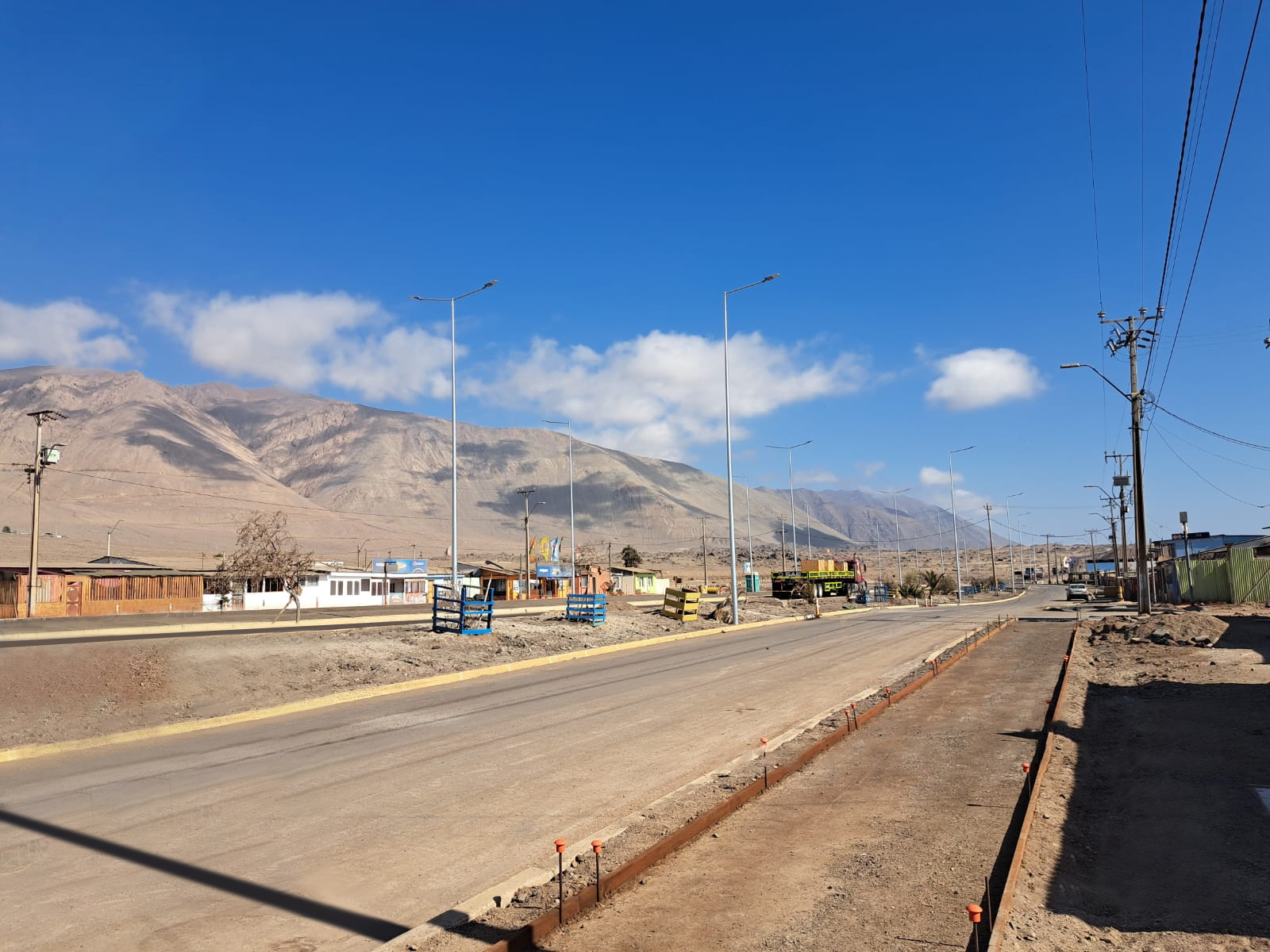
- Chile — municipal roadway lighting: 198 units installed for outdoor roadway and public facility illumination over a 10-year program, replacing traditional HID street lamps, with reported outcomes of better night lighting, higher energy efficiency, easier maintenance and improved safety.
- United Arab Emirates — highway roadway lighting: 2,000 units installed for an outdoor highway and public facility project with a 5-year duration, where solar and grid power complement each other to reduce energy consumption and emissions.
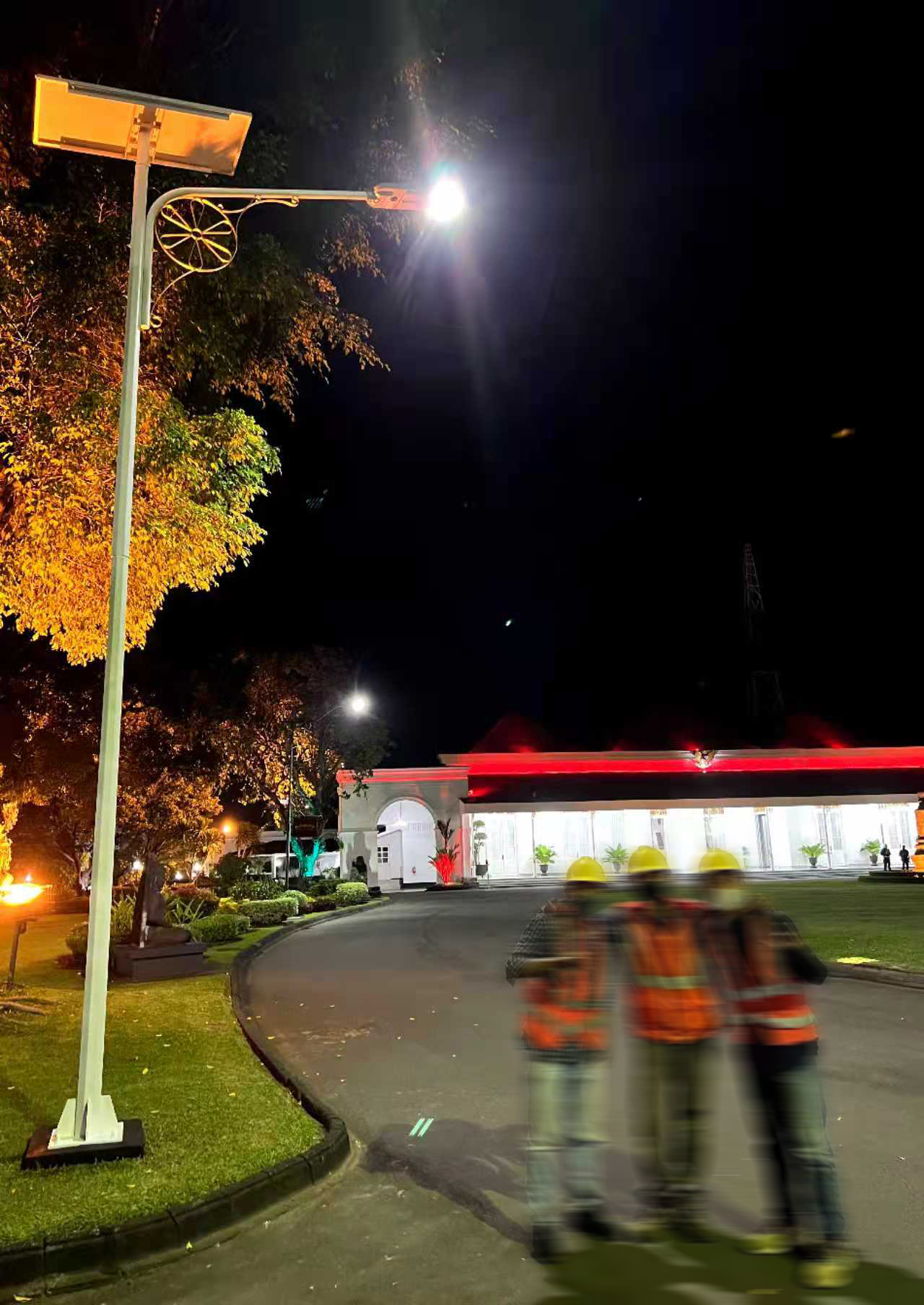
- Thailand — presidential palace solar lighting: a 10-year, 198-unit solar installation covering roadway and landscape lighting, reporting higher energy efficiency than traditional HID lamps alongside easier maintenance and improved safety.
These are roadway and public-facility programs rather than single-building installations. That distinction matters for maintenance planning: it is the multi-year operating cost, not the initial invoice alone, that usually decides the outcome of a municipal tender.
Side-by-Side Specification Table
| Evaluation dimension | AOK SD Series | Balder BI-S5A |
|---|---|---|
| Luminaire power range | 20–120 W | 70–120 W |
| Published LED efficacy | Up to 210 lm/W | 110 lm/W |
| Optical distributions | T2, T3, T4, T5 | Confirm current datasheet at RFQ |
| Solar panel and controller | Monocrystalline panel; MPPT controller with IoT support | Confirm current datasheet at RFQ |
| Battery | Lithium, 25.6 V, 30 Ah | Confirm current datasheet at RFQ |
| Colour temperature range | 3000 K–6500 K | Confirm current datasheet at RFQ |
| Published waterproof rating (luminaire) | IP65 | Confirm current datasheet at RFQ |
| Warranty | 3 years standard, 5 years optional | Confirm current datasheet at RFQ |
| Certification | CE / FCC / RoHS; other certificates on request | Confirm current datasheet at RFQ |
| Customization scope | Appearance, structural components, optical module, electrical circuit; OEM / ODM / SKD / CKD | Confirm current datasheet at RFQ |
| Typical best fit | Mixed-class programs, low-lumen segments, customization-heavy tenders | Standardized programs built around a single road class |
Selection Framework: Which Buyer Profile Fits Which Option
Once the sizing is done, the decision usually resolves to which profile describes the project.
Profile A — mixed-class rural and urban road program. The tender includes main carriageways, feeder roads and residential access streets. The AOK SD Series fits because a 20–120 W range covers the low-lumen segments without a second product family, and T2 through T5 optics cover the different widths.
Profile B — single-class standardized arterial program. Every pole is the same height, the same spacing and the same road class. Both platforms can serve this, since the 70–120 W overlap covers the requirement. Decide on total system cost — luminaire plus panel, battery, bracket and pole — rather than on unit price.
Profile C — OEM or owner-branded program. The buyer needs a private-label product with specific optics or electronics. The AOK SD Series fits because appearance, structural components, optical module and electrical circuit are all inside the customization scope, supported by OEM, ODM, SKD and CKD production modes.
Profile D — maintenance-constrained program. Field crews are limited, poles are difficult to access, or the road network is geographically dispersed. Modular component replacement plus IoT reporting on the MPPT controller supports exception-driven maintenance instead of fixed patrol schedules.
Profile E — volume rollout with an existing spares platform. If the buyer already operates a standardized luminaire from another supplier and the priority is supply-base breadth rather than optimization, the Balder BI-S5A at 70–120 W can remain a legitimate part of the shortlist. The trade-off is that higher system wattage carries a larger panel and battery for the same delivered light.
Frequently Asked Questions
What certifications should be confirmed before specifying AOK SD Series solar street lights for a public road project?
The AOK SD Series is published with CE, FCC and RoHS certification, with other certificates available on request. At company level, AOK holds ISO 9001 (certificate U919125Q30998R4M, GB/T 19001-2016, valid to 10 December 2028), ISO 14001 (certificate U919124E30857R1M, GB/T 24001-2016, valid to 12 December 2027) and ISO 45001 (certificate U919124S30768R1M, GB/T 45001-2020, valid to 12 December 2027). Where the destination market requires UL 1598 or IEC 60598-2-3 conformity, request the product-level documentation for the exact model and wattage rather than relying on a general certificate list.
Can the AOK SD Series be adapted to different road widths and pole layouts?
Yes. The SD Series offers T2, T3, T4 and T5 optical distributions, colour temperatures from 3000 K to 6500 K, and LED efficacy up to 210 lm/W. Where a layout falls outside standard patterns, AOK provides customization covering product appearance, structural components, the optical module and the electrical circuit design. Production modes include OEM, ODM, SKD and CKD, so a project-specific variant does not require a new product platform.
How does a higher-efficacy luminaire reduce the initial purchase cost of a solar street light system?
Efficacy is upstream of system size. At up to 210 lm/W, the AOK SD Series needs roughly half the fixture wattage that a 110 lm/W luminaire needs for the same delivered lumen target. Lower wattage means a smaller monocrystalline panel, a smaller lithium battery and a lighter mounting interface. A 20–120 W power range also allows low-traffic road segments to be matched rather than over-specified, and modular customization keeps project-specific engineering out of full tooling territory. The saving appears at system level rather than on the luminaire line item.
Can a sample be validated before committing to a full production order?
Yes. Sample validation before volume commitment is the normal route for road projects, because illuminance, uniformity and dimming behaviour are best confirmed on the actual configuration rather than on a datasheet. Production orders carry a minimum order quantity of 200 PCS, and acceptance can be structured around a pre-shipment test plus third-party inspection such as SGS. Delivery terms are available as EXW, FOB or CIF, and payment terms are typically 30% T/T in advance with 70% T/T before shipment, or L/C.
What are the lead time and after-sales commitments once an order is placed?
Standard lead time is 30–45 days. Quality control runs across more than 28 inspection procedures, and customization covers appearance, structural components, optical modules and electrical circuit design. Warranty on the SD Series is 3 years standard with a 5-year option. After-sales response is committed within 24 hours with resolution targeted within 48 hours. Buyers who want to move from evaluation to execution can request the full AOK product catalogue and current SD Series specification pack, or open a project inquiry at www.aokledlight.com to receive a configuration matched to their road classes.
Conclusion
The AOK SD Series and the Balder BI-S5A are not competing on the same axis. The BI-S5A's published 70–120 W range and 110 lm/W efficacy suit a program that is standardized, uniform and already oriented around a fixed platform. The AOK SD Series is built for programs that are not uniform: a 20–120 W span to match low-lumen road segments, efficacy up to 210 lm/W to cut fixture wattage and therefore panel, battery and bracket size, and T2, T3, T4 and T5 optics to fit real road geometry instead of forcing geometry to fit one optic.
The maintenance side carries the same logic. A modular architecture makes component-level replacement practical, the MPPT controller with IoT support opens the door to monitoring-driven upkeep, and CE, FCC and RoHS certification on the product line sits on top of ISO 9001, ISO 14001 and ISO 45001 management system certification at company level.
For buyers at the evaluation-to-execution stage, the decision rule is straightforward: classify your road segments first, size your energy budget second, and only then compare luminaires. If your project is mixed-class, customization-heavy, or maintenance-constrained, the AOK SD Series covers more of that program with one platform. If your project is a single standardized road class and you already carry a spares strategy for a fixed platform, either option can be made to work — and at that point total system cost should decide.
Next step: sample, specification or full catalogue
Request an SD Series sample for photometric validation, or ask for a configuration matched to your road classes and destination-market certification requirements. Project buyers can download the full AOK product catalogue here: AOK Product Catalogue (PDF).
Website: www.aokledlight.com | Email: info@aokledlight.com | Tel: +86-755-23579418 | WhatsApp: +86 15359133623
AOK Industrial Company Limited — Building 1, St. George's Science and Technology Industrial Park, Xinqiao Street, Shenzhen, China 518124
Have Questions or Need More Details?
Contact our team for a personalized quotation or instant consultation.
Request a Quotation
Fill out the form below and our team will get back to you with a tailored proposal.
WhatsApp Direct Chat
Prefer to chat in real-time? Message us on WhatsApp for instant assistance & quick answers.
- Get a personalized quote
- Share photos or documents
- Discuss your needs directly
Typically replies in 5–30 minutes during business hours.