
AOK SD vs. Balder BI-S5A: 2026 Solar Street Light Comparison
AOK SD vs. Balder BI-S5A: A 2026 Comparison Guide for Solar Street Light Projects
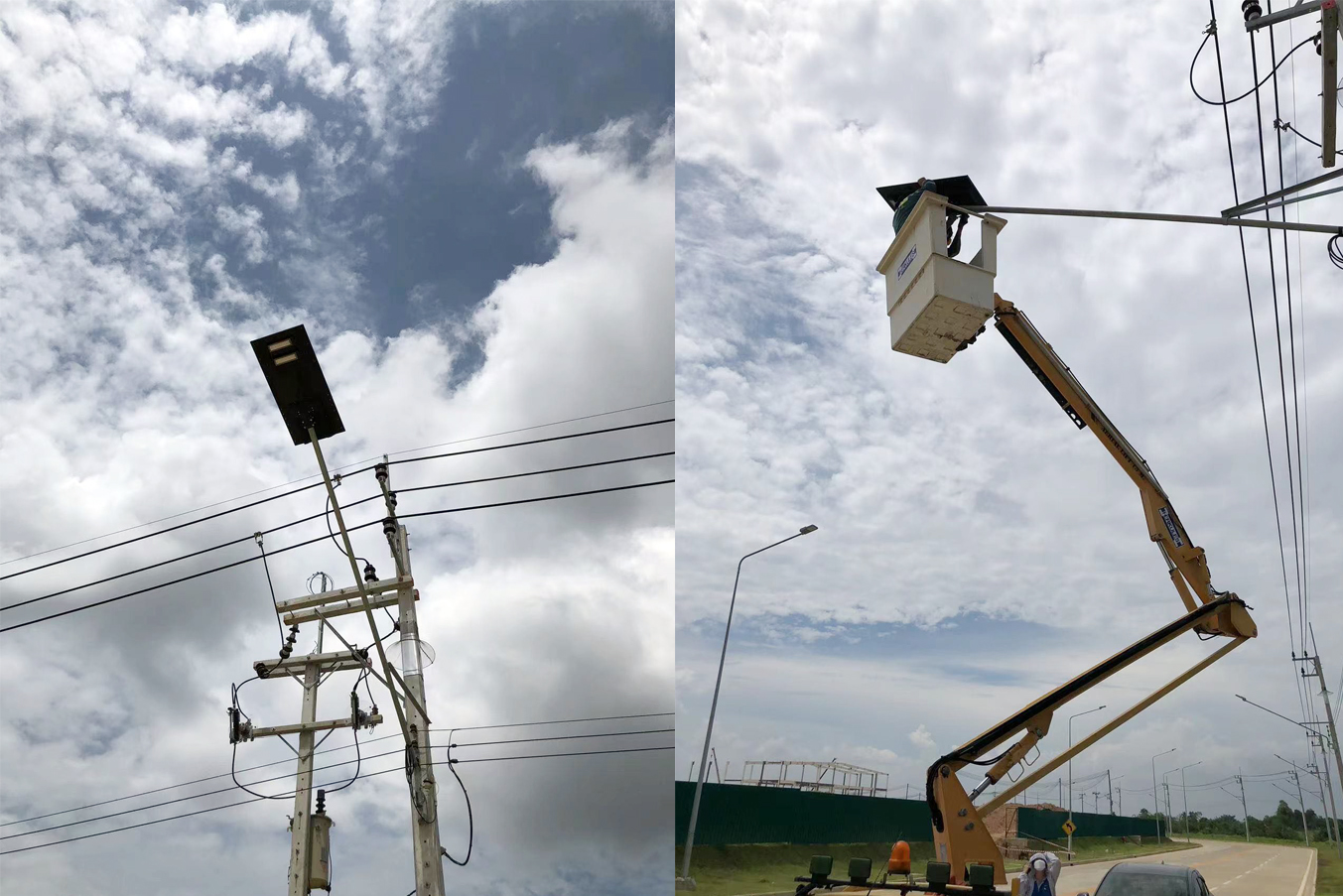
For standard urban and rural roads and residential projects, the AOK solar street light SD series and the Balder BI-S5A solve the same basic job with different priorities. The AOK SD series is positioned for cost-sensitive projects that need a wide 20-120W power range, LED efficacy up to 210 lm/W, flexible T2/T3/T4/T5 optics, and smart or IoT options. The Balder BI-S5A is positioned around a narrower 70-120W band, 110 lm/W efficacy, a bifacial double-glass solar panel, IP66 and IK10 protection, 205 km/h wind resistance, and a 10-year fixture warranty. The practical decision is not which product wins in every project, but which set of trade-offs matches the road, climate, maintenance model, and budget.
The short answer: which solar street light fits which project
The AOK SD series is the more flexible starting point when a buyer needs lower entry-level power options, broader power coverage, high LED efficacy, multiple optical distributions, and modular maintenance for standard roads and residential areas with 3-12m mounting heights. The supplied comparison positions it for cost-sensitive projects that also want PIR or microwave sensor options and potential IoT monitoring.
The Balder BI-S5A is the more specialized choice when the project environment is the dominant risk. Its supplied profile emphasizes heavier structural durability: IP66 and IK10 protection, 205 km/h wind resistance, a full metal anti-corrosion design, and a bifacial double-glass solar panel. The same comparison positions it for harsh coastal or hurricane-prone environments in Latin America, where long full-power runtime and a 10-year fixture warranty may matter more than the lowest initial purchase cost.
That does not mean either product is limited to one scenario. It means buyers should test each claim against the actual site conditions, local lighting requirements, and verification documents before award.
Why this comparison is more than a wattage decision
Solar street light procurement often starts with wattage because wattage is easy to compare. Wattage alone does not tell a buyer whether a luminaire will meet the road layout, whether the solar panel and battery can recover after cloudy days, whether the optics will put light on the carriageway instead of spill it, or whether maintenance will be practical after installation.
For the AOK SD and Balder BI-S5A, the comparison involves five linked decisions: power band and mounting height, LED efficacy and energy balance, optical distribution, battery autonomy and controls, and structural protection plus warranty. A lower-wattage option can be the correct choice for a residential lane, while a higher-wattage option with longer full-power runtime can be correct for a remote road. The buyer's job is to match the product profile to the lighting task, not to reward the largest number on a datasheet.
Product positions at a glance
AOK Industrial Company Limited was founded in 2012 and is based in Shenzhen, China. Its AOK solar street light SD series is presented as a modular solar street light family for standard urban and rural roads and residential zones. The key commercial argument is breadth: 20-120W power coverage, up to 210 lm/W LED efficacy, T2/T3/T4/T5 optical distributions, MPPT controller with IP67 rating, PIR or microwave sensor options, and potential IoT monitoring. The SD series is not positioned as a heavy-duty coastal structure first; it is positioned as a high-efficiency, cost-sensitive, configurable solar street light for standard projects.
The Balder BI-S5A is presented as a 70-120W solar street light with a stronger structural story. Its supplied comparison profile highlights a bifacial double-glass solar panel, IP66 and IK10 protection, 205 km/h wind resistance, and a full metal anti-corrosion design. It also carries a longer stated warranty: 10 years for the fixture and 5 years for the battery. Those features point to projects where wind, impact, corrosion, and long-term ownership dominate the decision.
Side-by-side comparison table
The table below uses only the facts supplied in the comparison set. Where a value is not stated for one product, the table says so rather than implying a capability gap.
| Decision factor | AOK solar street light SD series | Balder BI-S5A |
|---|---|---|
| Power range | 20-120W | 70-120W |
| LED efficacy | Up to 210 lm/W | 110 lm/W |
| Optical distributions | Flexible T2, T3, T4, and T5 distributions | No comparable optic-distribution detail is provided in the supplied comparison set |
| Solar panel | Single-side monocrystalline panel with MPPT, as described in the supplied efficiency comparison | Bifacial double-glass solar panel |
| Battery example | 80W model: 614.4 Wh | 538 Wh |
| Average charging time | 5 hours | 6 hours |
| Stated full-power runtime | 7.2 hours | 12 hours plus 3 nights autonomy |
| Controls | MPPT controller with IP67 rating; PIR or microwave sensor options; potential IoT monitoring | Microwave sensor with intelligent 3-night autonomy |
| Protection and structure | MPPT controller IP67 is stated; comparable luminaire IP, IK, and wind-speed figures are not provided in the supplied comparison | IP66 and IK10; 205 km/h wind resistance; full metal anti-corrosion design |
| Warranty position | Standard 3-year warranty, extendable to 5 years | 10-year fixture warranty and 5-year battery warranty |
| Cost profile | Typically lower initial purchase cost due to higher efficacy, broader entry-level options from 20W, and modular design reducing customization expenses | Premium price position tied to heavier-duty construction, bifacial panel, and extended 10-year fixture warranty |
| Best-fit conditions | Cost-sensitive standard urban or rural roads and residential areas, 3-12m mounting height, wide power coverage, high efficiency, smart or IoT options | Harsh coastal or hurricane-prone environments, especially in Latin America, where wind resistance, IK10 protection, and long-term durability dominate |
Power range and project fit
The AOK SD series covers 20-120W. That range matters most at the lower end. A 20W entry point gives buyers a way to specify a solar street light for a residential lane, a low-demand path, or a project phase where the lighting layout does not require a 70W or higher luminaire. The same series then scales to 120W for wider or more demanding standard roads.
The Balder BI-S5A starts at 70W and goes to 120W. That is not a defect; it is a narrower design envelope. A project that already requires 70-120W and prioritizes structural durability can evaluate both products within that band. A project that needs a 20W, 30W, or 40W option has no direct Balder BI-S5A starting point in the supplied comparison, so the AOK SD series has a practical advantage in procurement flexibility.
Buyers should still connect wattage to mounting height and road geometry. The supplied AOK positioning covers 3-12m mounting heights for standard urban and rural roads and residential areas. The same discipline applies to either product: confirm the required lighting class, pole spacing, mounting height, and maintenance access before selecting a wattage.
LED efficacy and the energy balance
Efficacy is the clearest numerical gap in the comparison. The AOK SD series is stated at up to 210 lm/W, while the Balder BI-S5A is stated at 110 lm/W. On paper, the AOK figure is nearly double. That difference can matter because a solar street light must produce lumens from a finite daily energy budget. Higher efficacy can allow more light from the same solar and battery capacity, or the same light from a smaller energy budget, depending on the final configuration.
Efficacy should not be read as a complete performance guarantee. Delivered lumens, optical efficiency, thermal behavior, driver losses, battery round-trip efficiency, and local solar conditions all affect what the installation delivers. The supplied comparison also gives a specific 80W example: 614.4 Wh battery capacity for the AOK SD series versus 538 Wh for the Balder BI-S5A, with average charging times of 5 hours versus 6 hours. Those figures show that the energy design is not identical, and they should be checked against the actual model configuration, not generalized to every wattage.
Runtime is the counterweight. The same comparison states 12 hours of full-power runtime plus 3 nights autonomy for the Balder BI-S5A, versus 7.2 hours for the AOK SD series. For a buyer who needs all-night full-power operation and several days of autonomy in a remote location, the Balder figure is a material advantage. For a cost-sensitive standard road or residential project where sensor control, dimming profiles, or a shorter full-power period are acceptable, the AOK emphasis on higher efficacy and lower initial cost may be more relevant.
The correct question is not simply which efficacy number is higher. It is whether the complete solar, battery, controller, and light package meets the required operating profile after accounting for weather, season, and maintenance assumptions.
Optics: T2, T3, T4, and T5 flexibility
The AOK SD series offers flexible T2, T3, T4, and T5 optical distributions. These distribution types describe how light is shaped and directed across the road. A narrower or offset distribution can suit one carriageway and pole arrangement, while a wider distribution can suit another. Having multiple options allows the lighting designer to match the luminaire to the road geometry instead of forcing one distribution across every project.
The supplied comparison does not provide comparable Balder BI-S5A optical distribution detail. That does not mean the Balder product lacks suitable optics; it means the supplied comparison set does not contain the detail needed to compare it on equal terms. Buyers evaluating Balder should request the applicable photometric files and distribution options for the exact model and configuration.
For either product, the practical check is the same: request photometric data and verify that the selected distribution meets the road layout, uniformity expectation, and glare control requirement for the project.
Structural durability and harsh environments
The Balder BI-S5A has the stronger supplied structural profile. IP66 addresses dust and water ingress, IK10 addresses impact resistance, 205 km/h wind resistance speaks to high-wind conditions, and the full metal anti-corrosion design targets long-term exposure. These are relevant in coastal areas, hurricane-prone regions, and sites where maintenance access is difficult or expensive.
The AOK SD series comparison states an IP67-rated MPPT controller, but it does not provide comparable luminaire IP, IK, or wind-speed figures in the supplied material. Buyers should not treat a controller rating as a luminaire rating. If the AOK SD series is being considered for a coastal or high-wind site, request the applicable luminaire IP rating, IK rating, wind-load information, and corrosion protection details for the exact configuration.
This is where the two products diverge most clearly. AOK is presented as a high-efficiency, cost-sensitive, configurable solar street light for standard roads and residential areas. Balder is presented as a heavier-duty structure for harsh environments. The buyer should match the environment to the evidence, not the other way around.
Maintenance, controls, and long-term ownership
The AOK SD series is described as easier to maintain through modular design, an MPPT controller with IP67 rating, PIR or microwave sensor options, and potential IoT monitoring for predictive upkeep. Modular maintenance can matter in projects with many poles, where service access and replacement logistics affect lifecycle cost. The IoT point should be read as a potential option, not proof of a deployed monitoring system in every project.
The Balder BI-S5A is described as simpler to own over the long term through its 10-year fixture warranty, 5-year battery warranty, microwave sensor with intelligent 3-night autonomy, and tool-free aspects in its all-metal corrosion-resistant build. The supplied comparison says these features are intended to minimize frequent interventions in remote areas. That is a reasonable positioning for sites where every service visit is costly.
AOK's risk-control material also identifies battery overheating, LED degradation, and water ingress as issues addressed through overcharge and over-discharge protection, temperature control, IP66 or IP67 waterproof design, real-time battery monitoring, and regular maintenance service. Those measures are relevant to either product category, and buyers should ask how they are implemented in the exact model being quoted.
Warranty length is not the same as reliability. A longer warranty can reduce risk and lifecycle cost, but it does not replace site verification, battery testing, or a clear service plan. The AOK standard 3-year warranty, extendable to 5 years, and the Balder 10-year fixture and 5-year battery warranty should be compared on the same project basis, including what is covered, who performs service, and how spare parts are supplied.

Initial cost and lifecycle value
The AOK SD series typically presents a lower initial purchase cost in the supplied comparison. Three reasons are given: higher efficacy means more light per watt, the series starts at 20W and therefore covers lower-cost entry configurations, and its modular design reduces customization expenses. That cost profile fits budget-sensitive road and residential projects where the lighting requirement can be met without the heaviest structural package.
The Balder BI-S5A carries a premium price position. The supplied comparison justifies that premium through heavier-duty construction, a bifacial double-glass panel, and an extended 10-year fixture warranty. For a harsh coastal or hurricane-prone site, that premium may be rational if it reduces structural risk and service interventions over the ownership period. For a standard inland road or residential area, the same premium may be harder to justify if the environmental demands do not require it.
Lifecycle cost should include the initial luminaire cost, solar and battery configuration, expected energy yield, battery replacement, service access, warranty terms, and the cost of any project-specific customization. The comparison does not provide delivered prices, installation costs, or replacement intervals, so those items must be confirmed in the commercial evaluation.
Step-by-step decision framework
- Define the lighting task. Confirm the road or residential application, mounting height, pole spacing, required lighting class, and local compliance requirements. The AOK SD positioning covers 3-12m mounting heights for standard roads and residential areas.
- Set the required power band. If the project needs 20-69W options, the AOK SD series has a clear starting advantage in the supplied comparison. If the project needs 70-120W only, both products can be evaluated within that band.
- Compare photometric fit. Request optical distribution data and verify T2, T3, T4, or T5 suitability for the AOK option. For Balder, request the comparable photometric detail for the exact model because it is not in the supplied comparison set.
- Check the energy balance. Compare efficacy, panel type, battery capacity, charging time, and full-power runtime for the actual configuration. Do not compare an 80W example across every wattage.
- Match controls to maintenance capability. Consider whether PIR or microwave sensors, MPPT control, IoT monitoring, or intelligent multi-night autonomy are useful for the site and service model.
- Match protection to the environment. For coastal, high-wind, or high-impact sites, request luminaire IP, IK, wind-load, and corrosion evidence. The Balder BI-S5A has the stronger supplied profile for those conditions.
- Compare warranty and service on equal terms. Review the AOK standard 3-year warranty with extension to 5 years against Balder's 10-year fixture and 5-year battery warranty, including coverage scope and service process.
- Request verification documents. Ask for model-specific photometric reports, battery data, protection certificates, and warranty terms before award.
- Evaluate cost on a delivered and lifecycle basis. Use the lower initial cost profile of the AOK SD series and the premium structural profile of Balder BI-S5A as inputs, not as final conclusions.
Use cases: where each product fits
AOK solar street light SD series
- Standard urban roads and rural roads where the buyer needs a broad 20-120W range and wants to avoid over-specifying every pole.
- Residential areas and low-demand paths where a 20W entry configuration can meet the lighting plan at a lower initial cost.
- Cost-sensitive projects that still need high LED efficacy up to 210 lm/W and flexible T2/T3/T4/T5 optics.
- Projects that value modular maintenance, MPPT control with IP67 controller rating, PIR or microwave sensors, and potential IoT monitoring.
Balder BI-S5A
- Coastal or hurricane-prone environments, particularly in Latin America, where 205 km/h wind resistance, IP66 and IK10 protection, and full metal anti-corrosion design are central requirements.
- Remote sites where 12 hours of full-power runtime plus 3 nights autonomy and a 10-year fixture warranty reduce service frequency and ownership risk.
- Projects that can accept a 70-120W band and are willing to pay a premium for heavier structural construction and a bifacial double-glass panel.
What to verify before selecting either product
The comparison set gives a useful decision framework, but it is not a substitute for project verification. Buyers should ask for model-specific photometric files, battery test data, charge and discharge protection details, IP and IK certificates where applicable, wind-load evidence for high-wind sites, and written warranty terms. For AOK, the company profile lists ISO9001, ISO14001, UL, TUV, and RoHS certifications; buyers should still confirm that the exact model and destination market are covered. The supplied comparison does not include Balder certificate numbers or test reports, so those should be requested directly.
Buyers should also separate stated capability from project outcome. A product may be designed for a 3-12m mounting height, but the final layout still depends on road width, pole spacing, and lighting class. A battery may have a stated capacity, but actual autonomy depends on solar resource, temperature, load profile, and control settings. Verification is not a paperwork exercise; it is how the buyer closes the gap between a catalog description and a reliable installation.
FAQ
Which compliance documents should buyers verify first?
Start with model-specific photometric reports, IP and IK certificates where applicable, battery and charging test data, and written warranty terms. AOK's company profile lists ISO9001, ISO14001, UL, TUV, and RoHS, but buyers should confirm that the exact SD series configuration and destination market are covered. The supplied comparison does not provide Balder certificate numbers or test reports, so those should be requested for the exact BI-S5A configuration.
Does the AOK SD series cover projects below the Balder BI-S5A power range?
Yes. The supplied comparison gives the AOK SD series a 20-120W range and the Balder BI-S5A a 70-120W range. That means AOK has entry-level options below 70W, while both products can be compared in the 70-120W band. The buyer should still confirm that the lower-wattage configuration meets the road or residential lighting requirement.
Why do T2, T3, T4, and T5 optics matter in a solar street light comparison?
Optical distribution determines how the luminaire places light on the road. The AOK SD series offers T2, T3, T4, and T5 distributions, giving the designer more ways to match the product to carriageway width, pole position, and spacing. The supplied comparison does not give comparable Balder BI-S5A optic details, so buyers should request Balder photometric files if optics are a deciding factor.
Which option has the lower initial cost, and which has the stronger lifecycle case?
The AOK SD series typically presents a lower initial purchase cost because of its higher efficacy, broader entry-level power options starting at 20W, and modular design that reduces customization expenses. The Balder BI-S5A carries a premium tied to heavier-duty construction, a bifacial double-glass panel, and a 10-year fixture warranty. The lifecycle case depends on the site: AOK fits cost-sensitive standard roads and residential areas, while Balder may justify its premium in harsh coastal or hurricane-prone environments.
How should buyers compare runtime, warranty, and maintenance?
Use the same wattage and operating profile. In the supplied 80W example, AOK lists 614.4 Wh battery capacity, 5-hour average charging, and 7.2-hour full-power runtime, while Balder lists 538 Wh, 6-hour average charging, and 12-hour full-power runtime plus 3 nights autonomy. AOK emphasizes modular maintenance, MPPT control with IP67 controller rating, PIR or microwave sensors, and potential IoT monitoring. Balder emphasizes a 10-year fixture warranty, 5-year battery warranty, microwave sensor with 3-night autonomy, and tool-free aspects in its metal corrosion-resistant build. Buyers who need a project-specific configuration review can use AOK's official website to ask about documentation and next steps.
Conclusion
The AOK SD series and Balder BI-S5A are not interchangeable default choices. The AOK SD series is the stronger fit when the project needs a broad 20-120W range, lower entry-level cost, high LED efficacy up to 210 lm/W, flexible T2/T3/T4/T5 optics, and modular maintenance with smart or IoT options for standard urban and rural roads and residential areas. The Balder BI-S5A is the stronger fit when the environment is the main risk and the project needs IP66 and IK10 protection, 205 km/h wind resistance, a full metal anti-corrosion design, longer full-power runtime, and a 10-year fixture warranty.
For a 2026 procurement decision, use the comparison table as a screening tool, then verify the exact configuration against the lighting plan, climate, maintenance model, and warranty terms. The best-value choice is the one whose verified performance matches the site, not the one with the most favorable single specification.
For project documentation and product review, the AOK LED outdoor lighting brochure is available here: AOK LED outdoor lighting brochure (PDF).
Have Questions or Need More Details?
Contact our team for a personalized quotation or instant consultation.
Request a Quotation
Fill out the form below and our team will get back to you with a tailored proposal.
WhatsApp Direct Chat
Prefer to chat in real-time? Message us on WhatsApp for instant assistance & quick answers.
- Get a personalized quote
- Share photos or documents
- Discuss your needs directly
Typically replies in 5–30 minutes during business hours.