
LED Outdoor Lighting Compliance: How AOK Lights Meet Regional Standards
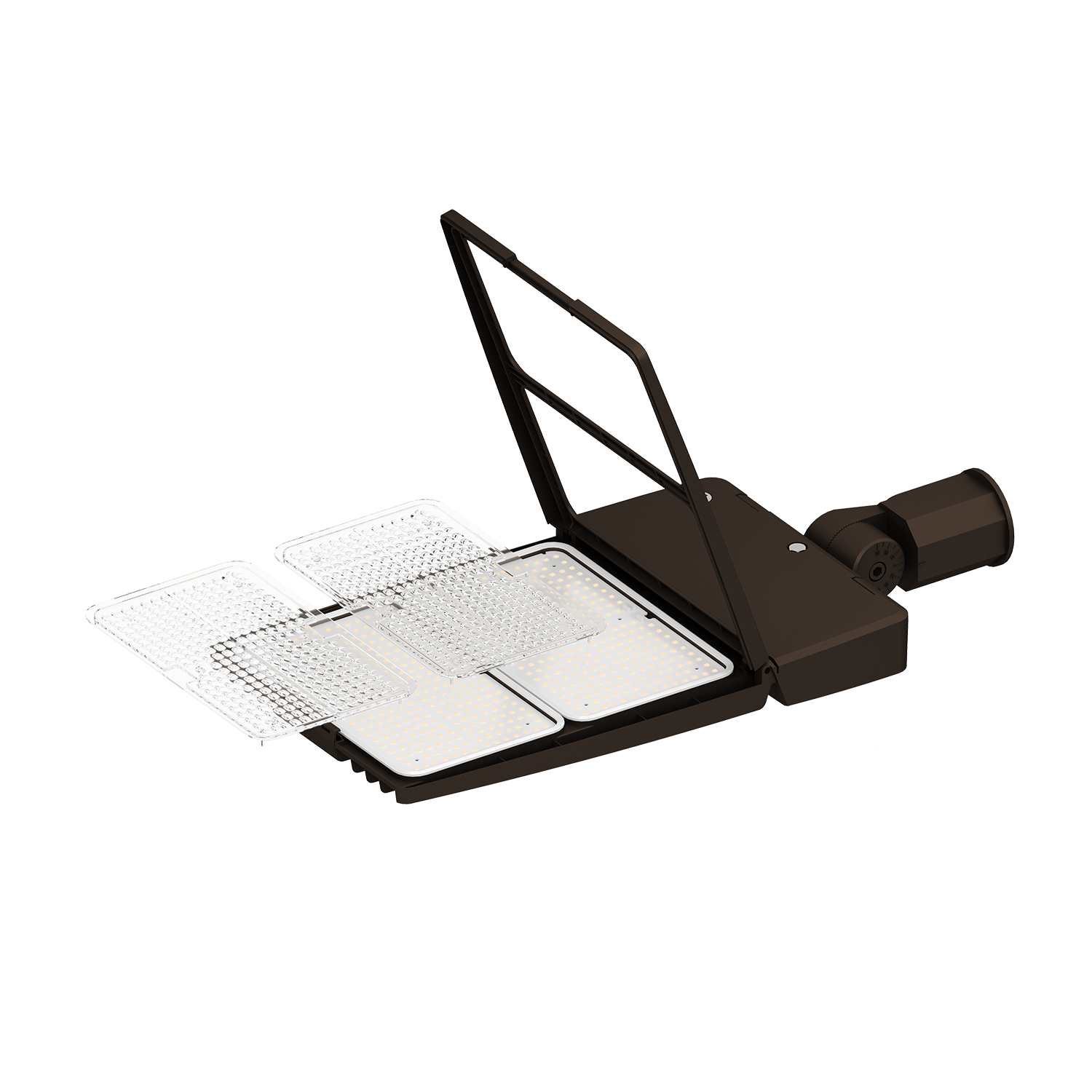
Compliance for LED outdoor lighting is not decided by a single certificate. It is decided by whether the document set behind a specific model answers the requirement list of a specific market and application. This walkthrough shows infrastructure buyers how to build that requirement list, map it to AOK's area, street, high-mast and stadium families — the Tool-less Area Light PLB, the LED Street Light ILA, the LED High Mast Light HMA and the Professional Stadium Lighting ISF — and what to request before a purchase order is signed.
The article does not assign standards to markets for you. Which standard, edition and marking scheme applies is set by the destination regulator and by your authority having jurisdiction (AHJ). What stays constant across markets is the documentation logic, and that is what the seven steps below fix in place.
The problem: catalogues sell fixtures, projects approve documents
Most approval failures in outdoor lighting do not come from a fixture that performs badly. They come from a document set that cannot be tied to the model on the purchase order. Three gaps cause most of the friction.
Brand-level evidence presented as model-level evidence. A management-system certificate or a brand certification page describes how a company is organised. It does not establish that a 150 W area light, in a specific colour temperature and optic, has been evaluated against a product standard. The distinction matters because the fixture — not the company — is what gets installed and inspected.
Ratings quoted without conditions. IP66, IK09, IK10, 160 lm/W and 190 lm/W are statements that hold only under defined test conditions. When a rating is carried from a family datasheet into a project specification without the report behind it, the buyer inherits an assumption rather than a verified property.
Project references read as type approvals. A completed stadium or highway installation is evidence of delivery capability under real project conditions. It is not a certificate, and it does not transfer automatically to a different site, mounting height or broadcast requirement.
The practical answer is to treat compliance as a mapping exercise: requirement category on one side, product family and supporting document on the other.
Why the documentation burden sits where it does
Outdoor lighting now spans roadway, area, high-mast, port, airport and sports applications inside a single procurement package, and each application pulls in a different set of requirement categories. That breadth is why documentation depth separates suppliers more than any single headline specification.
The category is also large enough that buyers rarely procure it in isolation: Grand View Research valued the global outdoor lighting market at USD 17.1 billion in 2024 (Outdoor Lighting Market Size Report, 2025–2030). Within it, solar street lighting — a segment AOK also supplies — was sized at USD 6.0 billion in 2025 by P&S Intelligence. A large and fragmented supply base means the buyer's main defence is a repeatable document request rather than a relationship.
The AOK evidence stack: what is documented today
AOK Industrial Company Limited is a Shenzhen-based LED lighting manufacturer founded in 2012. It produces LED street lights, stadium lights, high bay lights, solar street lights and industrial, seaport, airport and sports-field lighting, and reports exports to the EU, USA, Middle East and Asia. Its compliance evidence sits in three layers, and each layer answers a different buyer question.
Layer 1 — management-system certificates, which operate at organisation level
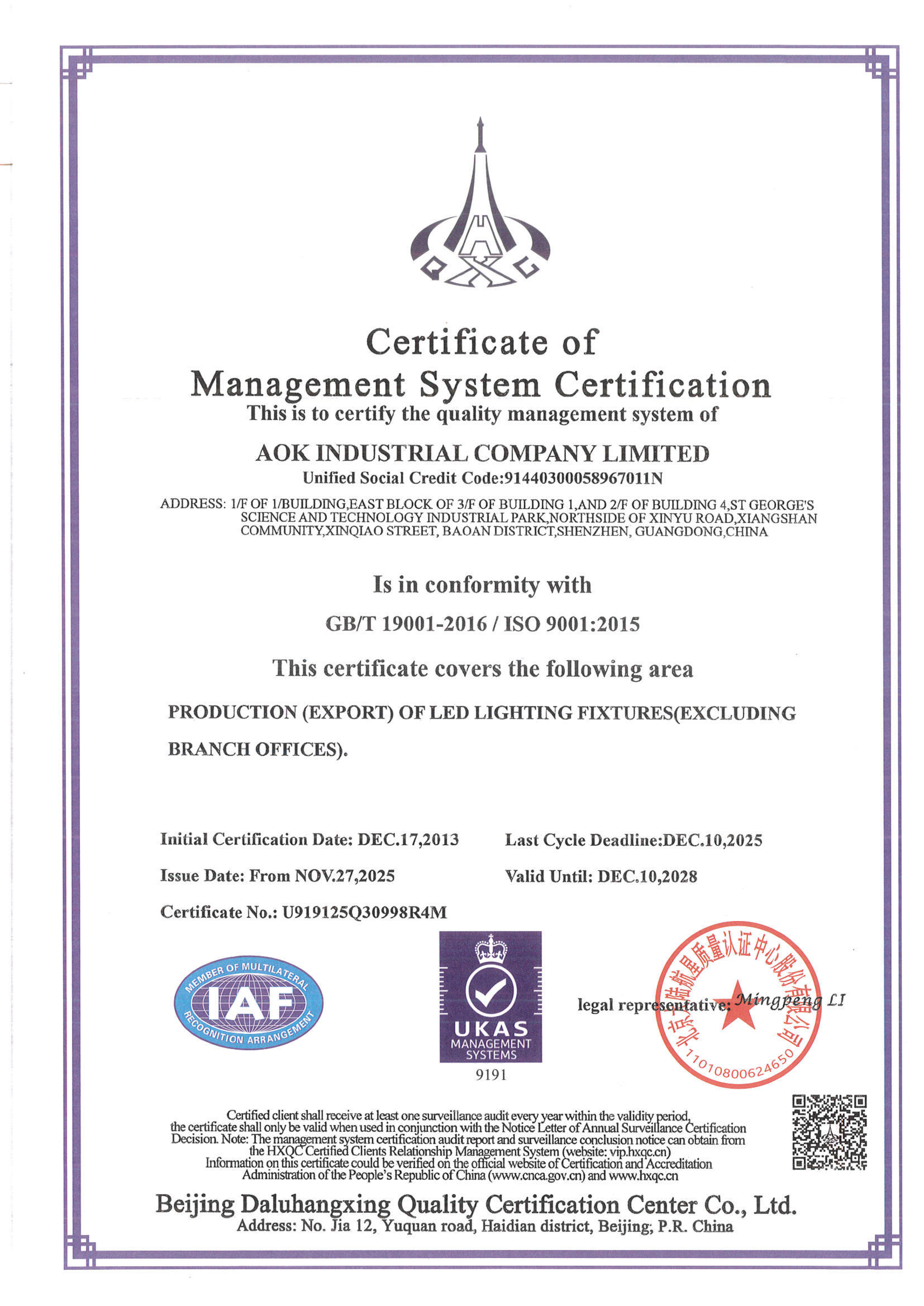
Three certificates are held and can be checked by number, issuing body and validity period:
- ISO 9001 — certificate U919125Q30998R4M, issued by Beijing Daluhangxing Quality Certification Center Co., Ltd. against GB/T 19001-2016, issued 27 November 2025 and valid to 10 December 2028.
- ISO 14001 — certificate U919124E30857R1M, issued by the same body against GB/T 24001-2016, issued 12 December 2024 and valid to 12 December 2027.
- ISO 45001 — certificate U919124S30768R1M, issued by the same body against GB/T 45001-2020, issued 12 December 2024 and valid to 12 December 2027.
All three carry the same scope wording — “Production (Export) of LED Lighting Fixtures (Excluding Branch Offices)” — and the same market listing: EU, US, Middle East, Southeast Asia, Australia, Africa and South America.
Read that scope literally, because it defines the boundary. The certificates confirm that the production and export of LED lighting fixtures is covered by a certified quality, environmental and occupational health and safety management system. They do not certify any individual luminaire against a product safety standard, and they do not name models. A buyer who needs model-level assurance has to ask for the model-level document.
Layer 2 — product-level listings, which differ by family
The listings are not uniform across the range, and that is the single most useful thing to know before drafting a specification. In the current product data:
- The Tool-less Area Light PLB lists UL, DLC 5.1 and FCC, with other certificates available on request.
- The Area Light Shoebox OT lists UL/cUL, FCC, CE, ENEC, SAA and RoHS.
- The 100 W / 150 W / 200 W CCT and power turnable LED High Bay lists UL/cUL, RoHS, CE, CB and TUV.
- The Solar Street Light SL lists CE and RoHS.
Two consequences follow. First, a certification family that appears somewhere in the AOK range should never be assumed for a different model — confirm it for the exact item on the order. Second, the mix signals which markets each family was primarily built for: DLC 5.1 on the PLB points at North American utility and rebate programme screening, while ENEC and SAA on the OT point at European and Australian acceptance.
Layer 3 — production and change control
Documentation is only as good as the production system behind it, and buyers can interrogate that too. AOK's stated capability set includes OEM/ODM/SKD/CKD production modes, private-label and project-protection agreements, more than 80 new product designs per year with patent protection, and 28+ quality inspection procedures. The stated customisation scope covers product appearance, structural components, optical module, electrical circuit and project simulation.
For a compliance file, the value of that layer is traceability. A design change to the optical module or driver circuit is exactly the kind of event that can invalidate a previously issued report, so change-notification and project-protection terms belong in the contract rather than in a brochure.
Step-by-step: mapping requirements to AOK area, street, high-mast and stadium lights
Step 1 — Build the requirement list before you open a catalogue
List requirement categories, not product names. For outdoor LED luminaires, the categories that recur across markets are electrical safety, electromagnetic compatibility, photometric and energy-programme performance, ingress and impact protection, hazardous-substance limits and — for sports venues — glare and broadcast performance. Add the project-level categories your site imposes: surge and circuit protection, corrosion resistance of the finish, and control-protocol compatibility.
Then attach two limits to every category: the standard edition your AHJ accepts, and the evidence type you will accept (certificate, accredited test report, or manufacturer declaration). Doing this first prevents the common reversal in which a supplier's existing certificate set quietly becomes the buyer's requirement list.
Step 2 — Assign each category to the right product family
Area, roadway, high-mast and stadium lighting are separate families with separate optics, mounting geometry and protection profiles, so the same requirement category lands differently on each.
Area and car-park lighting — Tool-less Area Light PLB. The PLB is documented at up to 160 lm/W with turnable 75 W / 100 W / 150 W power settings, 2700–6500 K with 3000 K / 4000 K / 5000 K adjustable, Ra70 or Ra80, IP66 and IK10 stated according to EN 60529 and EN 62262, and two distributions: T401 (110°×155°) and T402 (90°×150°). The housing is heavy-duty die-cast aluminium to EN AC-46100. For a car park or dealership forecourt, the acceptance questions are uniformity across the bay layout and impact resistance at pole height — which is why the IK10 statement and the T401/T402 choice belong in the same review rather than in separate boxes.
Roadway lighting — LED Street Light ILA. The ILA is documented at up to 190 lm/W, 2700–6500 K with Ra70/Ra80 options, IP66 and IK09 with tempered glass, and three distribution families: T2 (85°×150°, 110°×155°, 75°×150°), T3 (100°×160°, 90°×150°, 100°×145°) and T4 (115°×145°). Road classification drives the optic choice, so the specification should name the distribution type rather than accept “Type II to IV available”. Note also that the ILA carries IK09 with tempered glass while the PLB carries IK10; if a project standard fixes one value, the family choice follows from it.

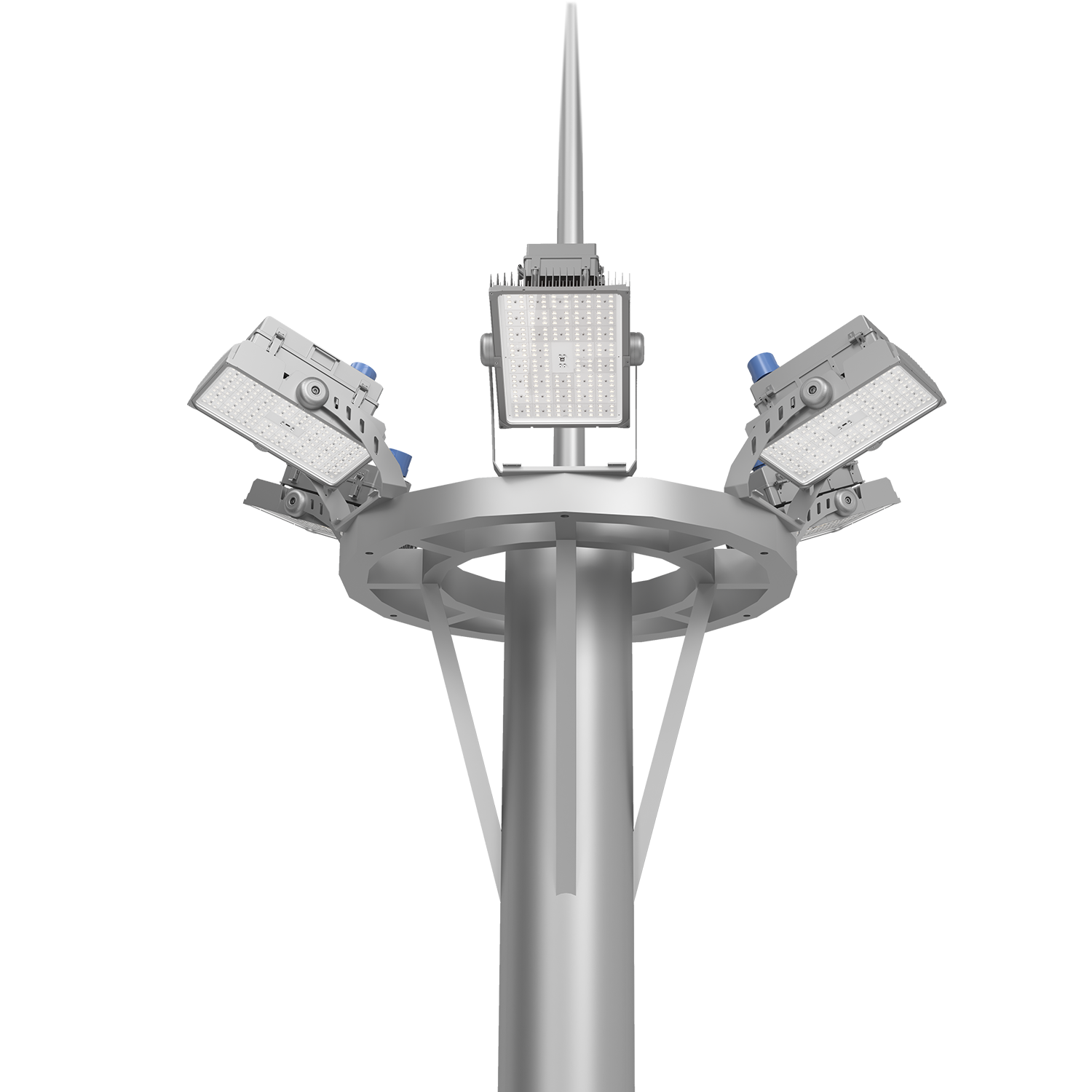
High-mast and port lighting — LED High Mast Light HMA. The HMA is documented at up to 56,000 lm, 2700–6500 K with Ra70/Ra80, IP66 and IK09 with tempered glass, Type III (20°×105°) and Type V (150°×150°) distributions, and Lumileds 5050, Seoul 5050 or OSRAM P8 LEDs in a heavy-duty die-cast aluminium housing to EN AC-46100. At 20–40 m mounting heights, access cost dominates the lifecycle calculation, so the meaningful compliance questions are which LED platform is named on the order and which warranty tier applies — 5 years standard, 10 years optional.
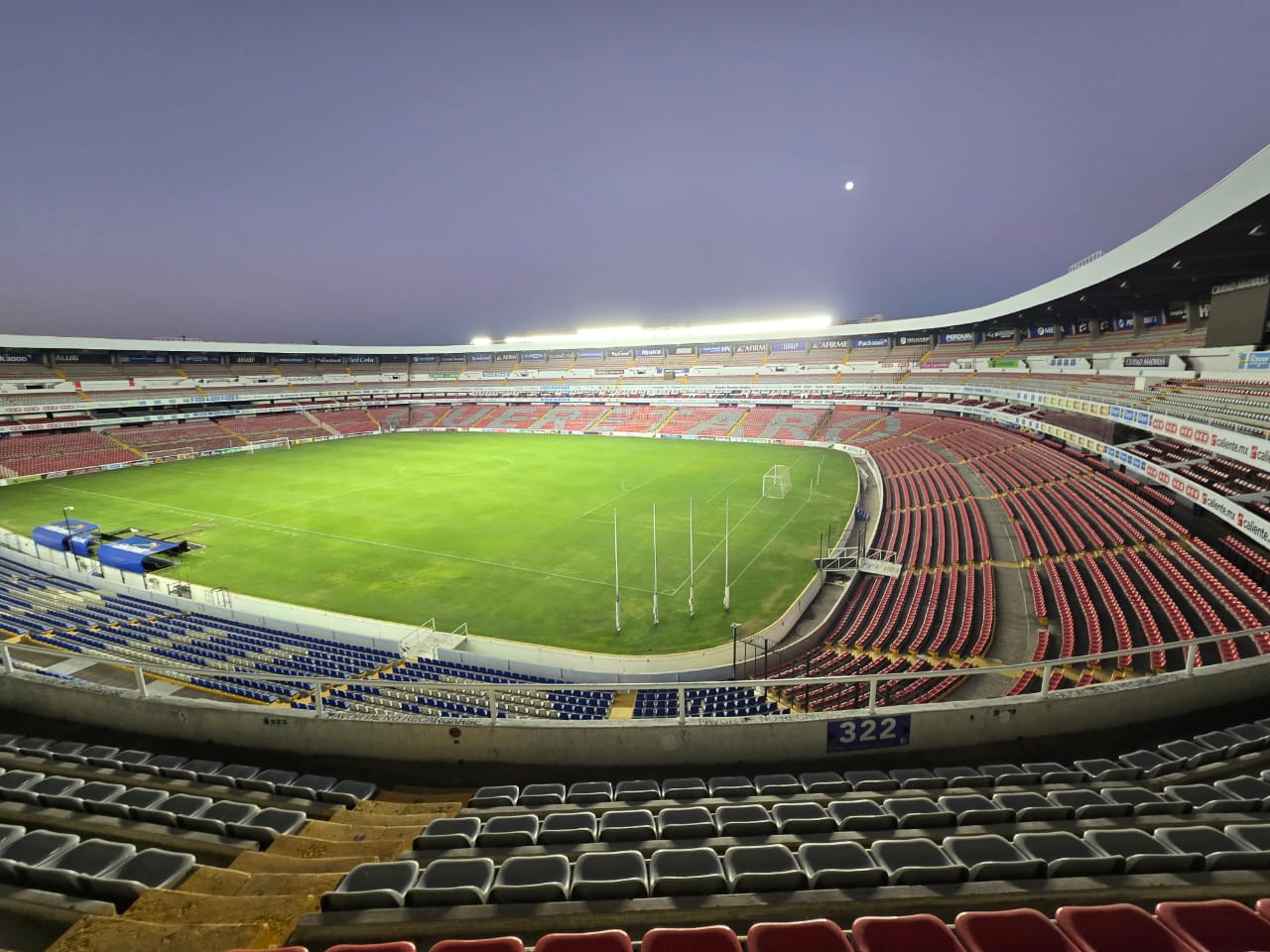
Stadium lighting — Professional Stadium Lighting ISF. The ISF is the model associated with AOK's FIFA stadium lighting system installation reference: a 380-unit project in Mexico recorded with a 10-year duration, DMX intelligent lighting control, back-light control and low glare for HD TV broadcasting. Treat that as project evidence, not as a certificate. If the venue needs a specific glare or broadcast class, request project-specific photometric and glare documentation for the same mounting geometry — a reference from another stadium does not transfer automatically. Where a documented IP and impact rating is the deciding factor, the Sports Stadium Light FSC in the same range states IP66 and IK10 with a PG60° (120°×40°) distribution and DALI/DMX512 dimming support, so both models are worth measuring against the venue brief.
Step 3 — Request documents per model, not per brand
Issue the request as a line-item list keyed to model, wattage, colour temperature and optic. A workable minimum set for each line is: the certificate or listing reference with number and issuing body; the test report behind any IP, IK, photometric or efficacy claim; the datasheet with stated test conditions; the declaration of conformity for the destination market; the label and marking artwork for review; and the warranty statement. Anything supplied only as a brand-level PDF should be returned with the model question restated.
Step 4 — Verify the certificate, not the logo
Four checks resolve most certificate disputes. Confirm the certificate number exists in the issuing body's records. Confirm the certificate holder matches the legal entity you are contracting with — AOK Industrial Company Limited, not a trading name. Confirm the scope wording actually covers LED lighting fixtures. Confirm the validity dates cover your delivery and installation window. The ISO 9001 certificate runs to 10 December 2028 while the ISO 14001 and ISO 45001 certificates run to 12 December 2027, so a project handed over after that date needs the renewal evidence added to the file.
Step 5 — Reconcile datasheet ratings with what the report measured
Efficacy is the usual place where numbers drift. “Up to 190 lm/W” on the ILA and “up to 160 lm/W” on the PLB are family-level maxima; the figure measured on site depends on wattage, colour temperature, CRI option and optic. Ask for the configuration that matches your order, and confirm whether the number refers to luminaire efficacy or LED efficacy, and at what input power.
The same discipline applies to colour temperature. The PLB's 3000 K / 4000 K / 5000 K settings and the 2700–6500 K range are not the same statement, and the acceptance criterion should say which one is being bought.
Step 6 — Write acceptance criteria into the purchase order
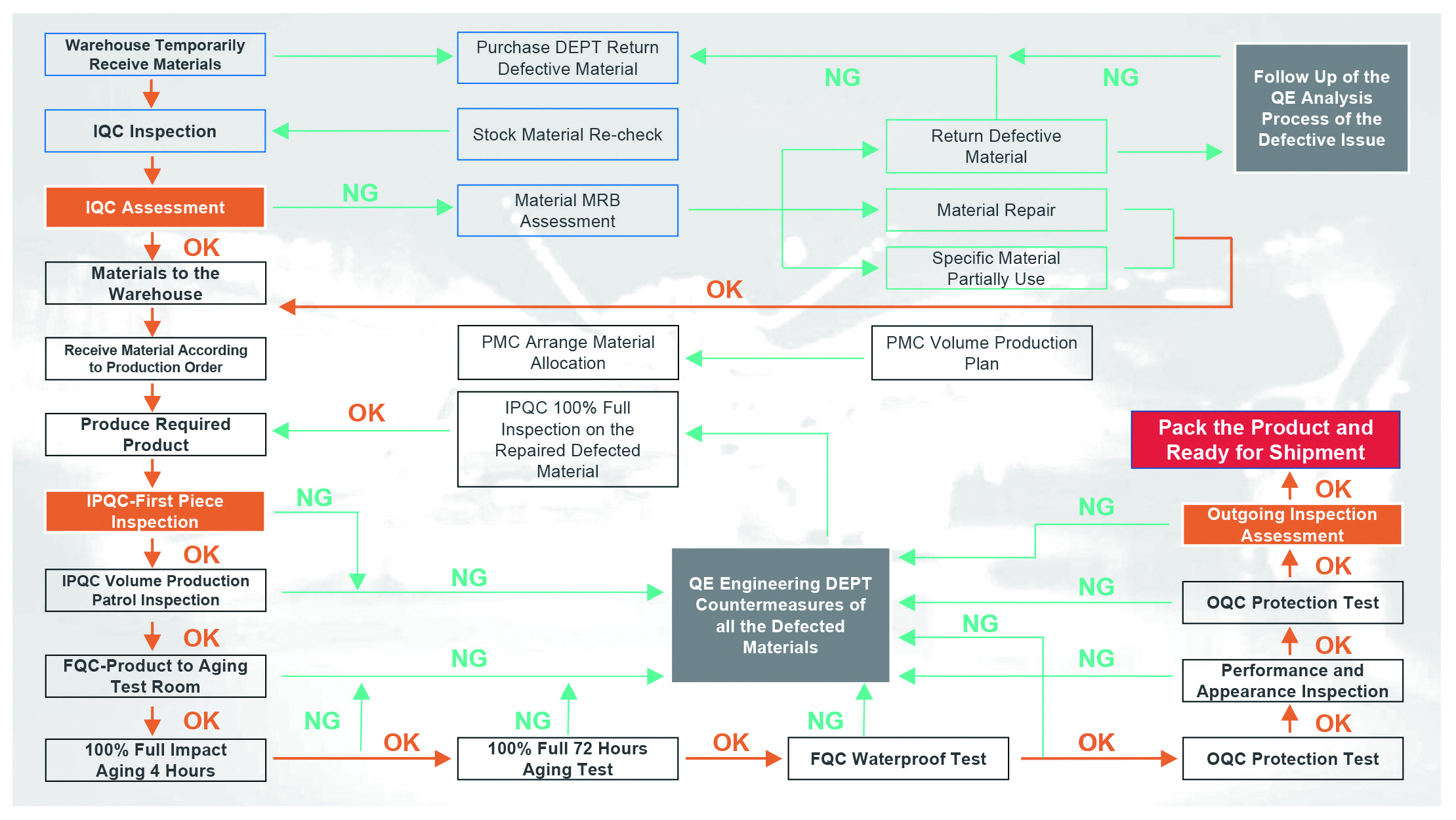
Convert the reviewed documents into contractual tests. Typical clauses cover approval of a pre-production sample against the agreed photometric configuration, a pre-shipment inspection against the 28+ inspection procedures AOK operates, label and marking verification against the approved artwork, and a packaging check for export transit. Add a change-notification clause covering LED platform, driver and optical module changes, because those substitutions are what quietly move a delivered batch away from the approved file.
Step 7 — Close the lifecycle loop
Compliance does not end at delivery. AOK's stated after-sales terms are a response within 24 hours and resolution within 48 hours, with warranty at 5 years standard and 10 years optional across the PLB, ILA, HMA and FSC families. Put the chosen warranty tier, the spare-parts basis and the escalation contact into the same document as the certificate pack, so that a failure three years later can be handled without re-establishing what was approved.
Product-family reference for the requirement file
The table condenses the documented parameters that matter at the compliance-review stage. It is a screening aid, not a substitute for the model-level document set described in Steps 3 and 4.
| Family and model | Documented protection and optics | Certifications listed in current product data | Documents to request before approval |
|---|---|---|---|
| Tool-less Area Light PLB | Up to 160 lm/W; 75/100/150 W power turnable; IP66 / IK10 per EN 60529 and EN 62262; T401 and T402 distributions | UL, DLC 5.1, FCC; other certificates on request | Listing reference for the ordered wattage and CCT; IP and IK test reports; distribution file for T401 or T402 |
| LED Street Light ILA | Up to 190 lm/W; IP66 / IK09 with tempered glass; T2, T3 and T4 distribution families | Market-specific; confirm on the project document set | Declaration of conformity for the destination market; photometric file matched to the road class; impact test evidence |
| LED High Mast Light HMA | Up to 56,000 lm; IP66 / IK09 with tempered glass; Type III (20°×105°) and Type V (150°×150°) | Market-specific; confirm on the project document set | LED platform confirmation (Lumileds 5050, Seoul 5050 or OSRAM P8); maintenance and access documentation; warranty tier |
| Professional Stadium Lighting ISF | Referenced in a 380-unit FIFA stadium lighting system installation with DMX control, back-light control and low glare for HD broadcast | Market-specific; confirm on the project document set | Project reference confirmation; control-integration documentation for DMX; glare and broadcast data for your mounting geometry |
Where this plays out: four project patterns
Commercial area lighting. A US supermarket car-park programme of 600 PLB units was recorded with a 10-year duration and with easier maintenance and safer night conditions as the stated outcomes after replacing HID parking-lot lamps. In compliance terms, the transferable element is not the unit count but the fact that a single family was held across the site, which simplifies the label and marking review.
Roadway lighting. A Chilean municipal roadway installation of 198 units and a 2,000-unit highway installation in the UAE were both recorded against AOK street and solar street families with a documented outcome of lower energy consumption and easier maintenance versus HID lamps. Roadway projects are where the distribution-type argument in Step 2 becomes contractual, because the optic choice is what the lighting design is approved on.
High-mast lighting. A 60-unit high-mast installation at a Canadian ski resort, recorded in 2019, lists stable operation, low glare and energy-bill savings as outcomes. High-mast references are the clearest illustration of why access cost belongs in the requirement list: at that mounting height, the warranty tier and the LED platform matter more than a small efficacy difference.
Stadium lighting. The 380-unit ISF installation in Mexico is the reference that buyers most often point to when asking about broadcast performance. It is a project record with stated control and glare characteristics — and the correct use of it is to open a conversation about your venue's geometry, not to close one.
Five compliance mistakes to avoid
- Accepting one certificate for a whole catalogue. The PLB lists UL, DLC 5.1 and FCC; the OT lists UL/cUL, FCC, CE, ENEC, SAA and RoHS. Different families, different listings.
- Treating an ISO certificate as product approval. The scope covers production and export of LED lighting fixtures, not the performance of a specific luminaire.
- Ignoring expiry against handover date. Two of the three management-system certificates expire on 12 December 2027.
- Specifying a family maximum as a site guarantee. “Up to 190 lm/W” and “up to 56,000 lm” are configuration-dependent figures, not delivered values at your CCT and optic.
- Leaving change control out of the contract. Without a notification clause, an LED platform or driver substitution can move the delivered product away from the approved file without any document being formally wrong.
Frequently asked questions
Which documents should an infrastructure buyer request for LED outdoor lighting compliance?
Request a model-level package, not a brand-level one. For each line item on the order — model, wattage, colour temperature and optic — ask for the certificate or listing reference with number and issuing body, the test reports behind any IP, IK, photometric or efficacy claim, the datasheet with its stated test conditions, the declaration of conformity for the destination market, the label and marking artwork, and the warranty statement. On the AOK range this matters because listings differ by family: the Tool-less Area Light PLB lists UL, DLC 5.1 and FCC, while the Area Light Shoebox OT lists UL/cUL, FCC, CE, ENEC, SAA and RoHS. A management-system certificate such as ISO 9001 U919125Q30998R4M belongs in the file as organisation-level evidence, but it does not replace any of the above.
How do I confirm that AOK's ISO certificates actually cover the fixtures on my order?
Check three things against the certificate itself: scope, holder and validity. All three AOK certificates — ISO 9001 U919125Q30998R4M, ISO 14001 U919124E30857R1M and ISO 45001 U919124S30768R1M — carry the scope “Production (Export) of LED Lighting Fixtures (Excluding Branch Offices)”, which covers fixture production and export but names no individual model. The holder should read AOK Industrial Company Limited, matching the contracting entity. Validity differs: the ISO 9001 certificate runs to 10 December 2028, while the ISO 14001 and ISO 45001 certificates run to 12 December 2027. If the model-level assurance is what your AHJ requires, the management-system certificate supports the file but does not satisfy that requirement on its own.
Can AOK support project-specific configuration, labelling and OEM documentation?
AOK states OEM/ODM/SKD/CKD production modes, private-label arrangements and project-protection agreements and approvals. The stated customisation scope covers product appearance, structural components, optical module, electrical circuit and project simulation, supported by more than 80 new product designs per year with patent protection and 28+ quality inspection procedures. For a compliance file, the practical output of that capability is a documented change path: if the optical module or driver circuit is adapted for your project, the revision should be recorded against the approved document set so that the delivered batch can still be traced to it.
What drives the budget difference between two apparently compliant offers?
Configuration and documentation scope, more than headline wattage. The variables that move a compliant offer are the power setting on a turnable family such as the PLB (75 W, 100 W or 150 W), the colour temperature and CRI option, the distribution optic, control and dimming requirements, whether the warranty is the 5-year standard or the 10-year option, and how much of the document set the supplier is expected to produce and translate. Commercial terms sit alongside them: AOK states a minimum order quantity of 200 PCS and a lead time of 30–45 days. A line-item quotation issued against your requirement list is the only reliable way to compare two offers that both claim compliance.
How should a sample be validated before mass production is released?
Approve the sample against the same configuration you will order, not against a generic demonstration unit. Confirm that the wattage, colour temperature and optic on the sample match the specification line; check the construction that the IP and IK statements depend on, such as tempered glass and die-cast aluminium housing to EN AC-46100; verify the label and marking artwork; and confirm the light distribution corresponds to the stated type — for example T401 or T402 on the PLB, or T2, T3 and T4 on the ILA. Retain the approved sample as the golden reference for the pre-shipment inspection, so later batches are checked against it rather than against a description.
What lead time and after-sales commitments apply to an AOK order?
AOK states a lead time of 30–45 days and a minimum order quantity of 200 PCS, with after-sales response within 24 hours and resolution within 48 hours. Warranty is 5 years as standard and 10 years optional across the PLB, ILA, HMA and FSC families. For a compliance file, the useful next step is to combine the commercial terms with the document request: ask for the current datasheets, the model-level certificate list for the exact wattage and colour temperature you intend to buy, and a quotation against your requirement list, all through the AOK website at aokledlight.com so the request can be tracked against the correct entity.
Conclusion: the document set is the product
An LED outdoor lighting package is approved on the strength of its paperwork, and the paperwork has to be specific. For an infrastructure buyer, the workable sequence is: build the requirement list from your AHJ's accepted editions, assign each category to the family that actually carries the relevant protection and optics, request evidence per model rather than per brand, verify certificate number, holder, scope and validity, reconcile datasheet maxima with the configuration you are buying, and write the acceptance criteria into the order.
The AOK range supports that sequence with an unusually explicit starting point: three management-system certificates with numbers and dates, product-level listings that differ by family, and documented parameters on the PLB, ILA, HMA and FSC that a buyer can test against a specification. The gaps to close are the ones no supplier can close in advance — your market's accepted standard editions, your venue's glare or uniformity targets, and the model-level reports for the exact configuration you intend to install.
To move from screening to approval, the AOK product introduction brochure can be downloaded here: AOK LED outdoor lighting brochure (PDF). Model datasheets, the current certificate list and a quotation against your requirement list can be requested through AOK Industrial Company Limited.

Have Questions or Need More Details?
Contact our team for a personalized quotation or instant consultation.
Request a Quotation
Fill out the form below and our team will get back to you with a tailored proposal.
WhatsApp Direct Chat
Prefer to chat in real-time? Message us on WhatsApp for instant assistance & quick answers.
- Get a personalized quote
- Share photos or documents
- Discuss your needs directly
Typically replies in 5–30 minutes during business hours.