
2026 AOK SD Solar Street Light Ranking by Project Priority
2026 Solar Street Light Recommendation List: Ranking AOK SD Configurations by Project Priority

AOK LED outdoor lighting portfolio for SD solar street light project screening.
A 2026 solar street light decision is usually a balance of energy yield, road geometry, controls, maintenance access and first cost. The AOK SD All-in-One Solar Street Light is specified across a 20-120W range, with efficacy up to 210 lm/W, T2/T3/T4/T5 optical distributions, an MPPT controller rated IP67, PIR or microwave sensor options and potential IoT monitoring. This recommendation list ranks SD configuration priorities for evaluation-stage buyers: efficiency-first, wide power coverage, flexible optics, maintenance and smart control, and cost-sensitive urban, rural and residential roads. The rank is a starting sequence for a stated project priority, not a universal product hierarchy.
Why a project-priority ranking beats a single-spec shortlist
Solar street light tenders often reduce the choice to wattage, lumen output or a single efficacy number. That approach hides the trade-offs that matter after installation. A higher-wattage luminaire may satisfy a lighting class but require more solar and battery capacity. A high-efficacy configuration may reduce energy demand but still fail a layout check if the optic sends light to the wrong place. A low-first-cost configuration may meet a residential road budget but become expensive if access for maintenance is difficult.
Project-priority ranking changes the first question from which SD model has the highest number to which SD configuration removes the dominant project risk. For an efficiency-first road, the dominant risk is solar energy yield. For a multi-road programme, it is SKU and spares complexity. For a junction-heavy layout, it is optical fit. For a remote site, it is maintenance and control. For a cost-sensitive residential scheme, it is first cost without sacrificing basic verification.
What changed for 2026 solar street light evaluation
Solar street lighting remains a project-specific category rather than a commodity fixture purchase. P&S Intelligence reports that the global solar street lighting market reached USD 6.0 billion in 2025. Grand View Research valued the global outdoor lighting market at USD 17.1 billion in 2024. These figures describe market scale, not AOK market share or SD performance; they explain why buyers are comparing more configurations and asking for clearer technical evidence.
AOK Industrial Company Limited was founded in 2012 and lists solar street lights among its main products. The All-in-One Solar Street Light-SD appears among the products covered by AOK's ISO9001, ISO14001 and ISO45001 management-system certificates. Those certificates support a management-system check, not a product-level photometric or safety approval. For procurement, they sit beside the SD datasheet, test reports and destination-market compliance file.
Ranking method: what the five SD priority profiles measure
The ranking uses four evaluation criteria: the project constraint that most affects lifecycle performance; the SD configuration feature that addresses that constraint; the evidence a buyer can request before award; and the verification burden that remains after the datasheet review. The order is not a laboratory ranking and does not use price data, field failure rates or independent photometric results, because those inputs are not part of this evaluation. It is a decision framework for the same AOK SD platform.
Use the rank that matches the project's primary constraint. If a project has two equal priorities, combine the relevant checks rather than averaging the ranks. A cost-sensitive project can legitimately start at Rank 5, while an efficiency-first project can start at Rank 1. The ordinal answers where to begin, not which configuration is universally better.
2026 AOK SD configuration ranking by project priority
| Rank | Project priority | SD configuration focus | Why it ranks here | Verify before award |
|---|---|---|---|---|
| 1 | Efficiency-first | High-efficacy SD configuration, specified up to 210 lm/W; wattage selected after lighting design | Solar yield, panel size or battery autonomy is the tightest constraint | Test basis, delivered lumens, input power, drive current, temperature and whether the value is maximum or typical |
| 2 | Wide power coverage | 20-120W SD platform | Supports different road types, phased procurement and consolidated spares | Wattage-specific PV, battery, controller, pole and mounting configuration |
| 3 | Flexible optics | T2, T3, T4 and T5 distributions | Road width, mounting height, spacing and junctions change the photometric need | IES or photometric file and layout calculation for the actual pole positions |
| 4 | Maintenance and smart control | MPPT controller rated IP67, PIR or microwave sensor options, potential IoT monitoring | Remote sites and distributed networks need fault visibility and controlled maintenance | Controller settings, IP67 evidence, sensor logic, gateway, protocol, data access and service scope |
| 5 | Cost-sensitive entry | Lower-power SD configuration within the 20-120W range, with standard optics and controls | First cost is the dominant constraint but basic verification still has to pass | Illuminance, uniformity, autonomy, warranty, spare parts and the same test package used for higher-power units |
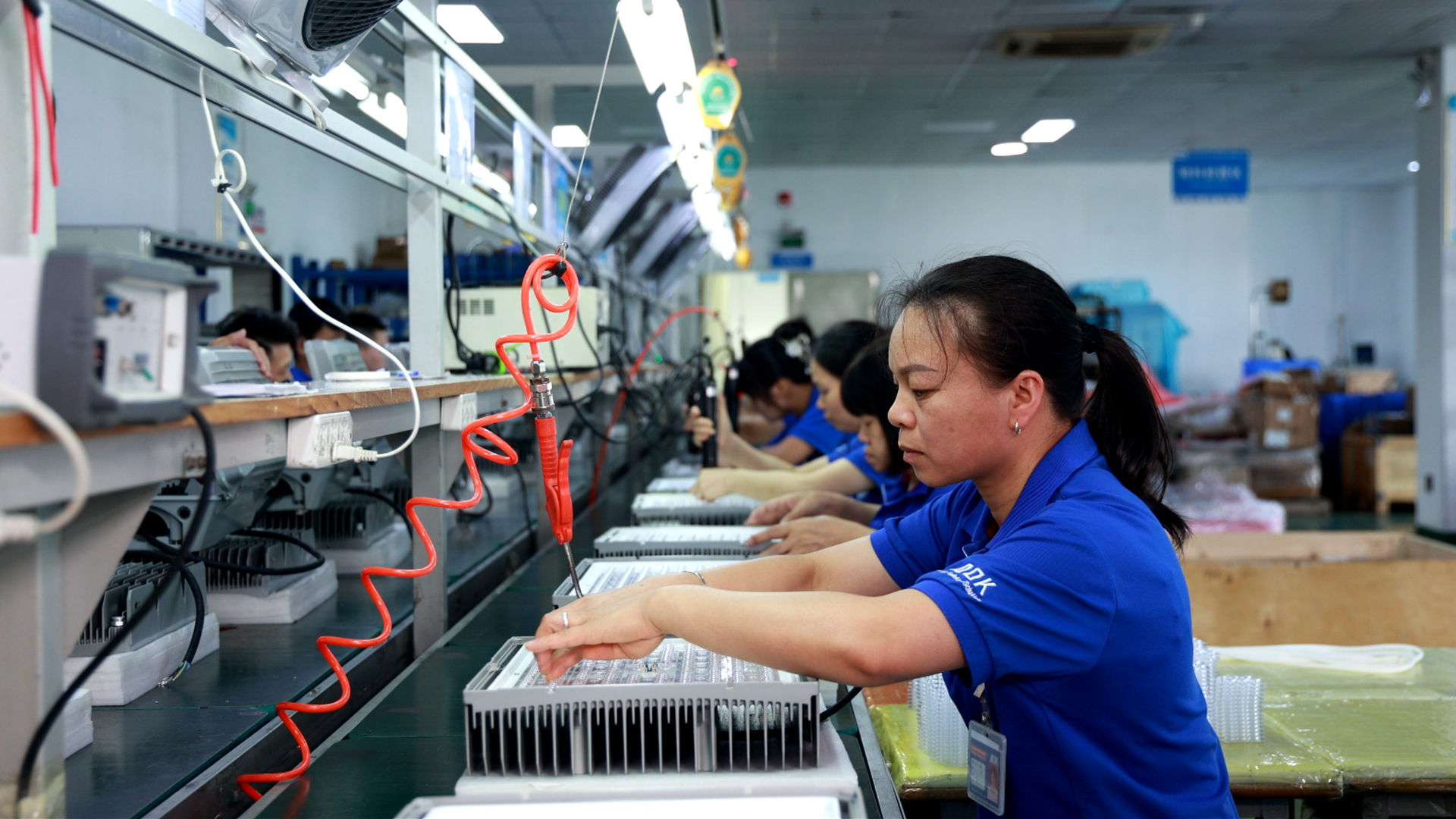
AOK Shenzhen production line for LED outdoor lighting.
Rank 1: Efficiency-first SD configuration
Priority fit: projects where solar yield, panel size or battery autonomy is the tightest constraint, and where the road layout is already defined. The SD series is specified up to 210 lm/W. That figure is an upper specification, not a promise that every installed luminaire will deliver 210 lm/W at the project's drive current, temperature and optic.
An efficiency-first evaluation should compare delivered lumens at actual input power, not the highest headline efficacy against a competitor's typical value. Ask for the test basis, drive current, ambient temperature, optic and whether the value is typical or maximum. Then check whether the higher-efficacy configuration changes the solar and battery sizing enough to justify its cost. If the layout is not fixed, Rank 3 may matter more than Rank 1 because the wrong optic can erase an efficacy advantage.
Project start: define the lighting class and pole spacing first, then select the lowest SD wattage that meets the layout with a verified efficacy margin. Do not select the highest wattage merely to chase a lumen target. The efficiency-first route is strongest when the design team can show that the selected configuration lowers energy demand without narrowing the lighting distribution or reducing maintenance access.
Rank 2: Wide power coverage from 20W to 120W
Priority fit: programmes that combine residential, collector and other road types, or projects procured in phases. The SD series spans 20-120W, which allows one product family to cover different demand levels. That range reduces the number of product families a distributor or project owner must support, but it does not prove that one wattage fits every road.
Wide coverage is valuable when the bill of quantities is not final. A buyer can standardise on the SD platform while keeping wattage as a late configuration decision. The procurement file should still list the exact wattage per pole, the corresponding PV and battery sizing, the controller setting and the optic. A 20W and a 120W unit may share a series name but behave differently in wind loading, mounting, maintenance access and energy yield.
Project start: group poles by layout and lighting requirement, then assign the lowest SD wattage that passes each group. Keep spare parts at the platform level, but approve the wattage-specific datasheet. For phased projects, require the supplier to confirm that later phases use the same controller family and connector strategy.
Rank 3: Flexible optics with T2, T3, T4 and T5 distributions
Priority fit: roads with changing widths, intersections, crossings, residential edges or mounting-height constraints. The SD series is specified with T2, T3, T4 and T5 distributions. In common roadway practice, Type II is a narrower asymmetric distribution, Type III is a general roadway distribution, Type IV is wider, and Type V is symmetric for area or intersection-style layouts. The practical difference depends on the actual photometric file, mounting height, tilt, spacing and target illuminance.
Optics are not a cosmetic option. A distribution that is too narrow can leave gaps between poles; one that is too wide can spill light beyond the carriageway and create glare at the property line. For a residential road, the evaluation should include obtrusive-light limits and glare control where local rules apply. For a junction or widening, a single distribution across every pole may be the wrong simplification.
Project start: request an IES or photometric file for each T2/T3/T4/T5 option and run the layout with the actual pole positions. Compare average illuminance, uniformity and glare metrics required by the project. Do not approve an optic from a type label alone. If the design team cannot obtain the photometric file, treat the optic choice as unverified.
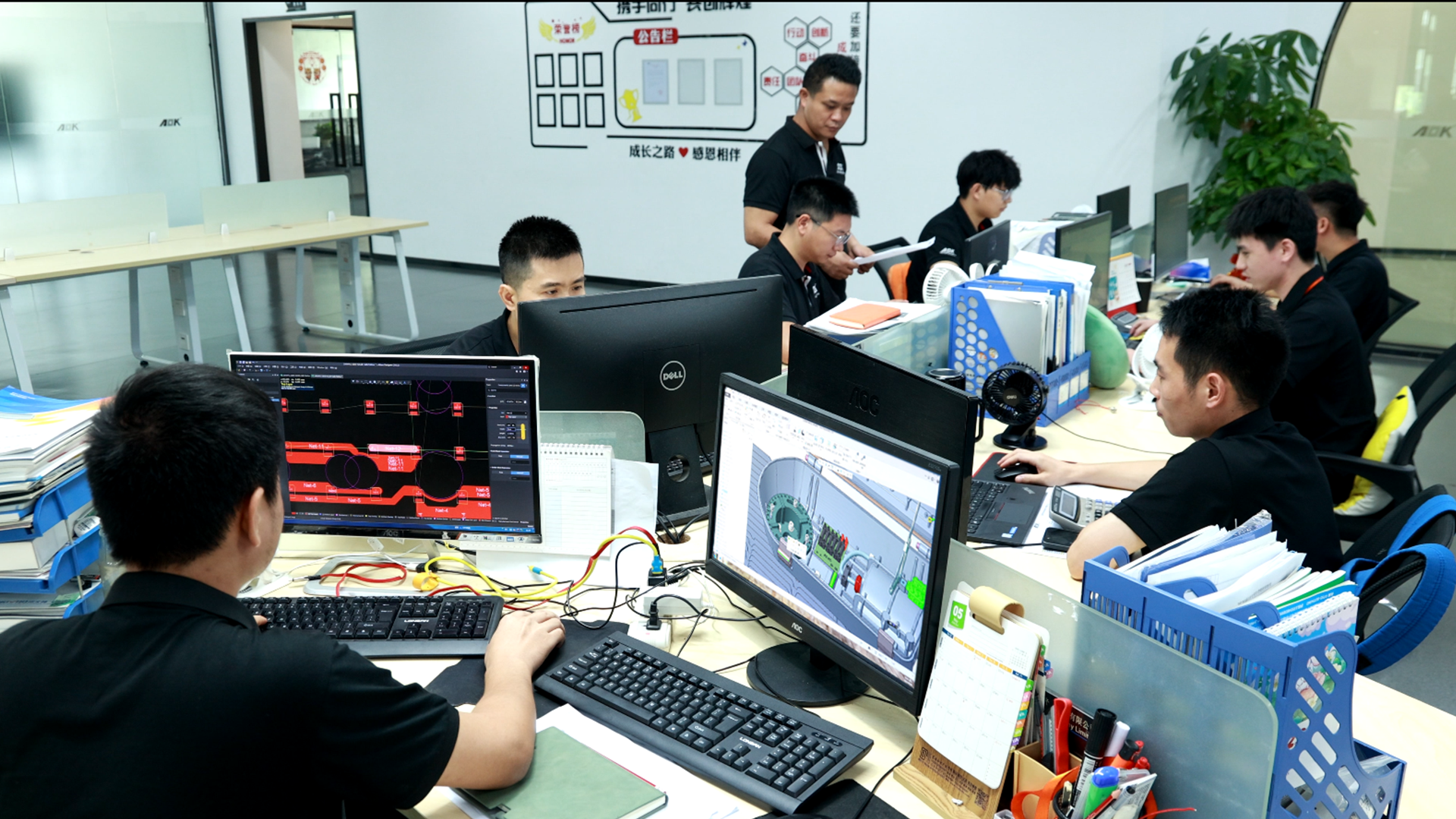
AOK R&D department supporting solar street light optics and controls.
Rank 4: Maintenance and smart-control configuration
Priority fit: remote roads, sites with expensive access, distributed municipal networks and projects that expect monitoring beyond basic dusk-to-dawn operation. The SD series is specified with an MPPT controller rated IP67, PIR or microwave sensor options and potential IoT monitoring. These features change the maintenance model, but they do not remove the need for correct system sizing.
An MPPT controller tracks the solar array's operating point to improve energy harvest under changing irradiance. In practice, that is most useful when the panel is partially shaded, the weather is variable or the system is sized close to the load. The benefit still depends on panel, battery, load and controller settings. IP67 indicates dust-tight protection and protection against temporary immersion under defined test conditions; it is not a blanket guarantee against every installation error.
PIR or microwave sensors can switch or dim the luminaire when activity is detected. That can support energy management, but the specification should state the dimming profile, hold time, detection range and failure mode. IoT monitoring is a potential option, not a standard feature in every SD configuration. If monitoring is required, confirm the gateway, communication protocol, data ownership, alarm logic and service agreement. A monitoring dashboard without a maintenance process is only a display.
Project start: separate mandatory functions from optional ones. Put MPPT and IP67 in the technical requirement; put sensors and IoT in the operational requirement. Require a site-level control narrative and a spare-parts plan. For remote sites, compare the cost of access against the cost of monitoring and remote diagnostics.
Rank 5: Cost-sensitive urban, rural and residential entry configuration
Priority fit: first-cost-sensitive roads where the lighting layout is simple and the project can verify basic performance without adding every control option. Start with a lower-power SD configuration within the 20-120W range, a standard optic from the T2/T3/T4/T5 set and only the controls the project will actually use. This is a starting point, not a licence to omit photometric design or product verification.
Cost reduction should come from matching the configuration to the road, not from deleting evidence. For a residential or rural road, the main risks are under-lighting, poor uniformity and maintenance access. A lower-wattage unit with a suitable optic can be a rational choice if the layout confirms the required illuminance. The same unit may be a false economy if the pole spacing forces a higher drive current or a larger solar system later.
Project start: fix the road classification and spacing, run a layout with the lower-power SD option, and compare it with the next wattage up. Ask for the same test-report and warranty package you would require for a higher-power unit. If the project cannot verify the lower-power layout, move to Rank 2 or Rank 3 rather than approve an unverified cost saving.
Where the Balder BI-S5A comparison belongs
The Balder BI-S5A is useful as an external benchmark for efficiency and power range only when both products are compared on the same basis. This ranking does not assign Balder BI-S5A an AOK SD rank and does not infer missing Balder specifications. If a tender names the Balder BI-S5A, place the current verified power range and efficacy figures beside the SD's 20-120W range and up to 210 lm/W specification. Confirm test standard, drive current, temperature, optic and whether each value is maximum or typical.
If the Balder figure is not available on a comparable basis, exclude it from the ranking rather than fill the gap with an assumption. A power range or efficacy headline alone does not establish lifecycle cost, lighting quality or suitability for a specific road. The benchmark is a screening input, not an award decision.
How to apply the ranking to common 2026 projects
Cost-sensitive urban and rural roads
Start with Rank 5 if first cost is the dominant constraint. Define the lighting class, pole spacing and required uniformity before selecting the lower-power SD option. If the road includes junctions, widening or mixed surface conditions, add the Rank 3 optic check. If the solar resource or winter autonomy is tight, move to Rank 1. Do not use a lower-wattage unit solely because the project budget is fixed; use it only after the layout confirms performance.
Residential zones
Residential schemes often need controlled glare, predictable maintenance and a simple control strategy. Rank 5 is the natural starting point for low-power residential streets, with Rank 3 used to check property-line spill and uniformity. If the scheme is part of a larger municipal programme, Rank 2 may be more efficient because one SD platform can cover several road types. Sensors are optional; confirm that dimming does not create unacceptable dark periods on pedestrian routes.
Multi-road or phased programmes
Rank 2 is the strongest starting point when the bill of quantities spans several road classes or future phases. Standardise the platform, but keep wattage, optic and control settings as approved configuration items. This reduces spares complexity without pretending that one configuration fits every pole.
Remote or maintenance-constrained sites
Rank 4 should lead when access is difficult or the owner needs fault visibility. Confirm MPPT and IP67 requirements, sensor behaviour and the real scope of IoT monitoring. If monitoring is optional, price it as a separate line so the project can compare the lifecycle benefit against the access cost.
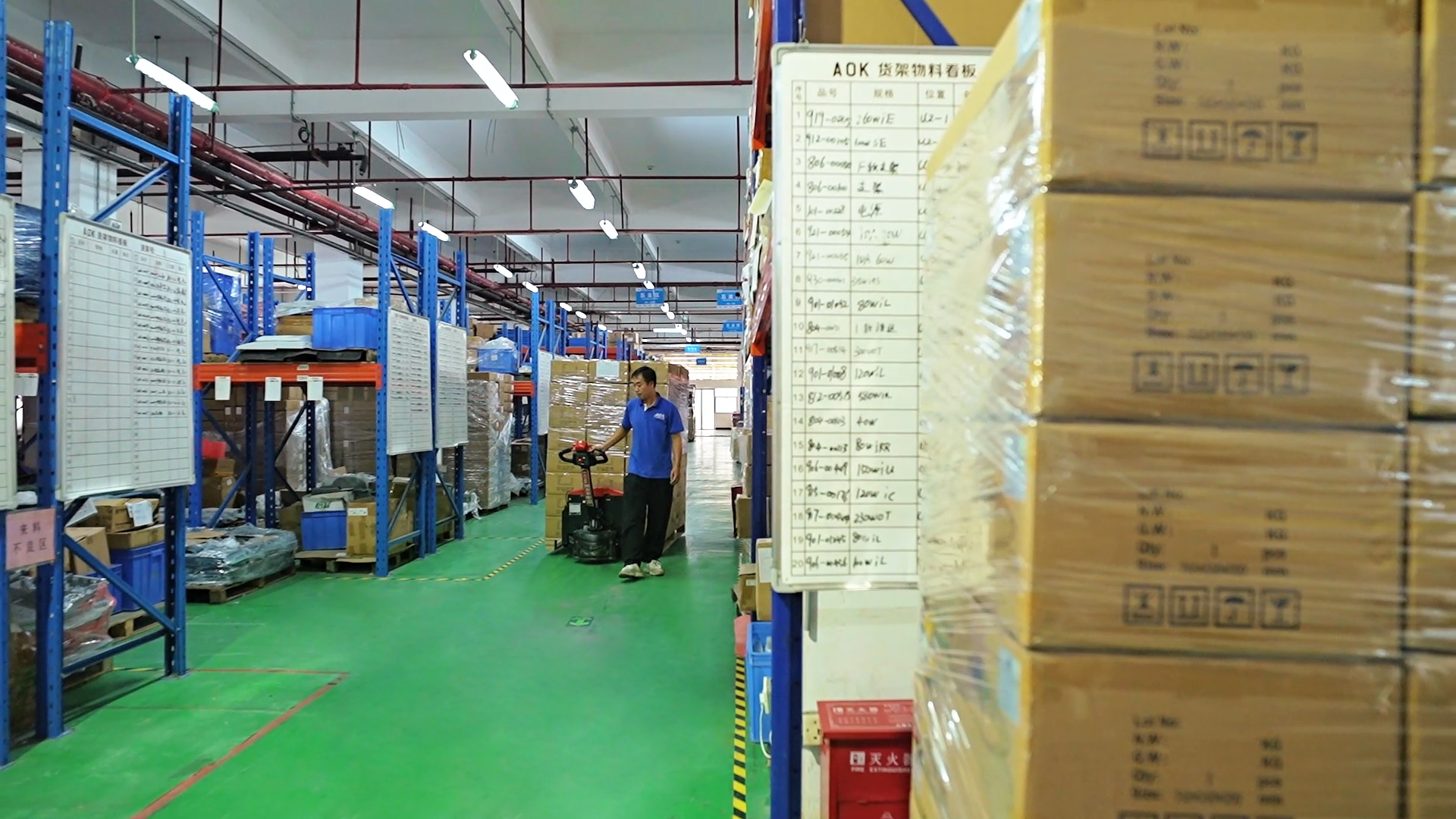
AOK Shenzhen warehouse for LED outdoor lighting orders.
Procurement checks before an SD configuration is approved
Use the following checklist to turn the ranking into an evaluation file. It applies to all five ranks.
- Datasheet match: confirm the exact SD model, wattage, optic, controller, sensor and mounting configuration. Do not accept a series-level datasheet as a substitute for the configured item.
- Photometric evidence: request the IES or photometric file and the layout calculation for the actual pole spacing and mounting height. Check average illuminance, uniformity and glare against the project requirement.
- Efficacy basis: verify whether the up-to-210 lm/W value is maximum or typical, and confirm the test conditions. Compare delivered lumens and input power, not headline efficacy alone.
- Controller and protection: confirm MPPT settings and IP67 test evidence. Ask for the surge, thermal and enclosure assumptions that apply to the installed environment.
- Sensor and IoT scope: define PIR or microwave behaviour, dimming profile, hold time and fail-safe state. For IoT, confirm gateway, protocol, data access, alarms and service responsibility.
- Management-system and product compliance: AOK's ISO9001, ISO14001 and ISO45001 certificates cover the production of LED lighting fixtures under the stated scope. Request the product-level certificates and test reports required by the destination market; management-system certification is not a product approval.
- Supply terms: AOK states OEM/ODM/SKD/CKD capability, a MOQ of 200 PCS and a lead time of 30-45 days. These are commercial inputs to confirm for the project schedule, not evidence of SD field performance.
- Quality and after-sales: AOK states 28+ quality inspection procedures, an after-sales response within 24 hours and resolution within 48 hours. Ask how these commitments apply to the selected SD configuration and spare-parts plan.
- Sample or pilot: test the configured unit under the project's dimming, sensor and solar conditions before full release. Record the test setup and results.
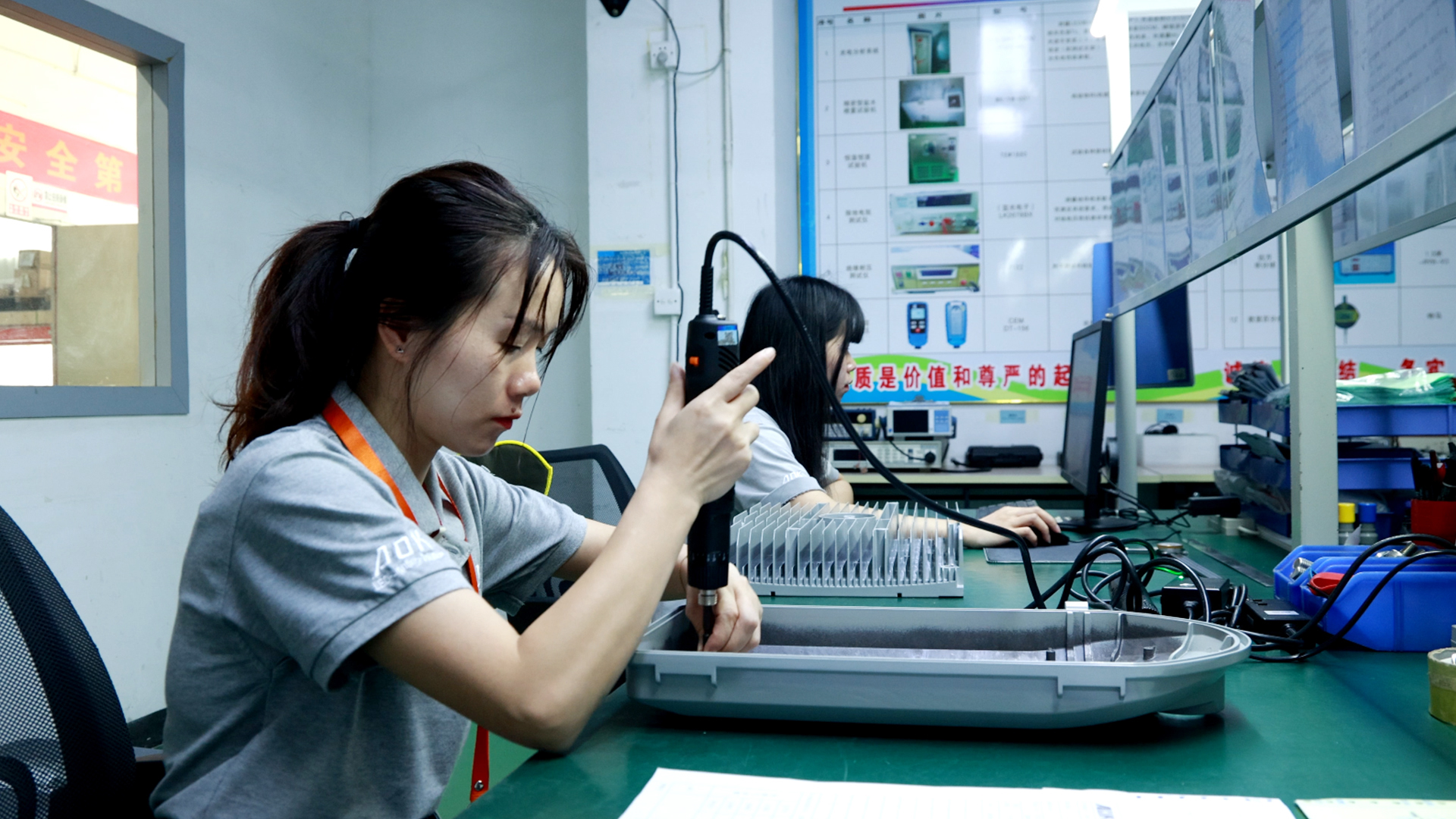
AOK quality control inspection for LED outdoor lighting.
FAQ: ranking AOK SD configurations for 2026 projects
Start with Rank 1 and verify the efficacy basis before selecting wattage. The SD series is specified up to 210 lm/W, but the project should compare delivered lumens at actual input power and confirm the test conditions. If the layout is not fixed, complete the optic check first because a poor distribution can outweigh an efficacy advantage.
Compare only on the same basis: delivered lumens, input power, test standard, drive current, ambient temperature, optic and whether the figure is maximum or typical. Do not set a maximum efficacy value against another product's typical value. Also check the complete solar street light system, including panel, battery, controller and autonomy, because a luminaire efficacy number alone does not establish project performance.
The optic should follow the layout, not the other way round. T2, T3, T4 and T5 provide different distributions, so the project should request photometric files and test the actual pole spacing, mounting height and road width. Use the distribution that meets illuminance, uniformity and glare requirements with the fewest over-lit or dark zones.
No. MPPT and IP67 are useful controller and enclosure attributes, but reliability also depends on system sizing, battery selection, thermal conditions, surge protection, wiring, installation quality and service access. The procurement file should connect the controller requirement to the full system design and the warranty terms.
IoT monitoring is described as a potential option, not a standard feature in every configuration. If the project needs monitoring, confirm gateway availability, communication protocol, data ownership, alarm logic, spare parts and the service process for responding to alarms.
Use Balder BI-S5A only as an external benchmark for efficiency and power range where verified, comparable data exists. Do not assign it an AOK SD priority rank or infer missing specifications. If the figures are not on the same test basis, exclude them from the ranking and request comparable datasheets from both suppliers.
Define the road layout, lighting class and pole spacing first, then request the configured SD datasheet, photometric file and sample for the lower-power option. AOK's catalogue can be downloaded here: AOK LED outdoor lighting catalogue. Use it to shortlist wattage and optic, then confirm the final configuration against the checklist above before award.
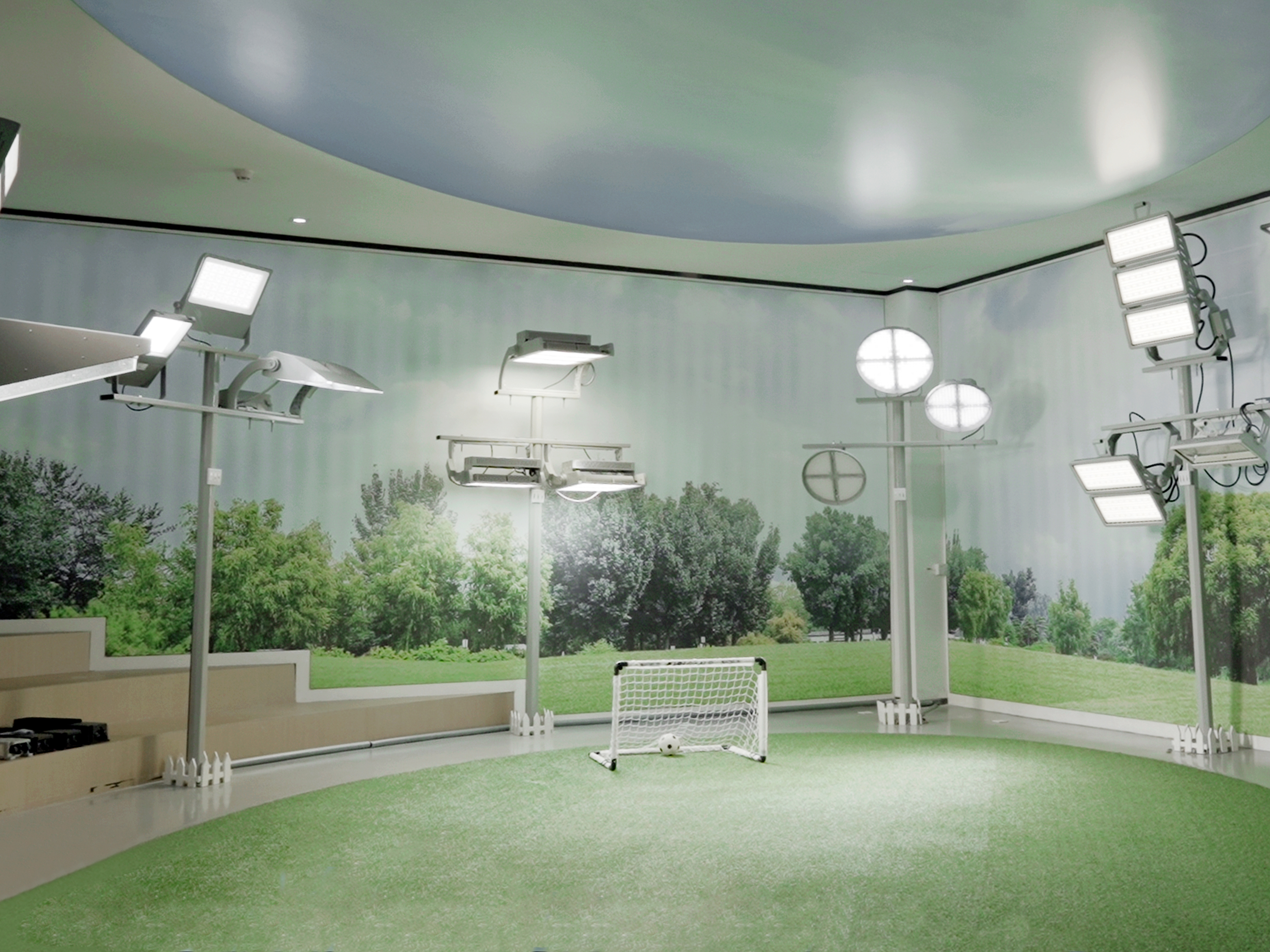
AOK Shenzhen showroom for solar street light configuration and sample review.
Selection summary. For 2026 projects, use Rank 1 when energy yield is the main risk, Rank 2 for wide power coverage, Rank 3 for difficult road geometry, Rank 4 for maintenance and smart control, and Rank 5 for a verified cost-sensitive start. The AOK SD platform should be approved only after the configured wattage, optic, controller, sensor and compliance file have been checked against the actual project layout.
Conclusion
The strongest 2026 solar LED street light decision is not the one with the highest single specification. It is the configuration that matches the project's dominant constraint and can be verified before installation. AOK SD configurations offer a useful decision range: 20-120W for coverage, up to 210 lm/W for efficiency-first screening, T2/T3/T4/T5 optics for layout fit, MPPT IP67 control for energy management, PIR or microwave sensing for activity-based operation and potential IoT monitoring for maintenance visibility.
Use this ranking as a procurement sequence. Start with the project priority, request the configured datasheet and photometric evidence, compare only verified figures, and keep Balder BI-S5A in its proper role as an external benchmark rather than an assumed rank. This ranking applies to the AOK SD solar street light platform; it does not rank LED stadium lights, high mast LED lights, LED flood lights or port area flood lights.
Have Questions or Need More Details?
Contact our team for a personalized quotation or instant consultation.
Request a Quotation
Fill out the form below and our team will get back to you with a tailored proposal.
WhatsApp Direct Chat
Prefer to chat in real-time? Message us on WhatsApp for instant assistance & quick answers.
- Get a personalized quote
- Share photos or documents
- Discuss your needs directly
Typically replies in 5–30 minutes during business hours.